
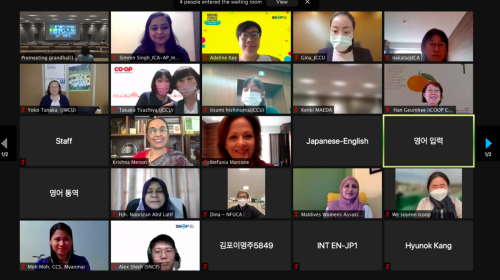
The 11th Asia and Pacific Regional Women’s Forum was held in conjunction with the 33rd ICA Congress on Deepening Our Cooperative Identity on November 29, 2021. It served as a timely platform to discuss why the Cooperative Identity matters to women. It was attended by over 60 participants who joined the forum virtually and onsite in Seoul.
The identity of women cooperators is embedded within a wide range of social, economic, cultural, political, and religious contexts, which shape and influence their identity and position in society. The Cooperative Identity rooted in principles and values offers women the opportunity to organise themselves to realise their common economic, social and cultural needs irrespective of their diverse backgrounds and contexts.
The forum deliberated on how the Cooperative Identity positively impacts women cooperative members from diverse backgrounds; issues and challenges experienced by women in practising cooperative principles and values; and what can be done to further strengthen the positive impact.
The episodes of intra and inter-state conflicts and violence against women are increasing. The forum encouraged an exchange of views between cooperators on the impact of conflict and violence on women and sought their recommendations for the inclusion of peace and non-violence in the Statement of Cooperative Identity.
The opening session was addressed by the acting Chairperson of the ICA-AP Committee on Women, Ms. Chitose Arai and the keynote address was delivered by Mr. Balasubramanian Iyer, Regional Director, ICA-AP. He presented the perspective of Cooperative Identity in the context of the Asia and Pacific region.
Ms. Stefania Marcone, a senior cooperative leader from Italy and ICA Gender Equality Committee Member moderated the first session on ‘In Praxis: Cooperative Principles and Values for Women’. It featured four cases:
- Principle 1: Voluntary and Open Membership by Ms. Anahita Eslahpazir, CEO, Rah-e-Roshd, Iran
- Principle 2: Democratic Member Control by Ms. Yoko Tanaka, Vice-President, Japan Workers’ Cooperative Union, Japan
- Principle 3: Member Economic Control by Ms. Elenita V san Roqu, CEO, Association of Asian Confederation of Credit Union, Thailand
- Principle 5: Education, Training and Information by Dr. Ahyoung Kim, Fellow Research Professor, iCOOP, South Korea
Dr. Krishna Menon, Professor at the School of Human Studies, Dr. B.R Ambedkar University, New Delhi, moderated the second session on ‘Peace and Non-Violence as Prospective Values in the Cooperative Identity.’ The session featured a video presentation of Puthukkudiyiruppu (PTK) Women Entrepreneurs’ Cooperative Society from Sri Lanka, supported by the International Labor Organisation (ILO). The (PTK) Cooperative is an association of conflict-affected women and a collective of women entrepreneurs in Sri Lanka’s Northern Mullaitivu district. The cooperative stands uniquely placed as the sole all-female cooperative in the district, having been formed in 2016 via the facilitation and guidance of the ILO-implemented ‘Local Empowerment through Economic Development’ (LEED) project. Currently, the cooperative has 1900 members, of which 43% are female-headed households who were also ex-combatants during the conflict.
During the panel discussion, the distinguished speakers - Ms. Chitose Arai, Mrs. Om Devi Malla (Senior Vice-Chairperson, National Cooperative Federation of Nepal and ICA Global Board Member), Ms. Aisha Salem (Head of Gaza Office, Economic and Social Development Centre of Palestine), and Ms. Khin Moh Moh (Deputy General Manager, Central Cooperative Society, Myanmar) presented their views on peace and non-violence and their importance for women cooperators in particular. Mrs. Malla noted that “the competitive advantage of the cooperative approach is the best alternative to make equal level playing field for women and deprived classes of the society. Although the overall activities of cooperatives contribute to peace, consensus cooperation is impossible”.
Ms. Aisha Salem observed that “there is a peculiarity regarding the status of the Palestinian women cooperators as they suffer from double violence. On one hand, the Israeli occupation practices violence against Palestinian women in many forms, starting with killing, arresting, targeting, and violating basic rights such as residence, housing, freedom of movement, and denial of access to health, education, social security, and other rights. On the other hand, Palestinian women still suffer from internal societal violence based on a patriarchal culture based on discrimination against women in all aspects of life. This discrimination finds its manifestation in the prevailing laws and regulations in force in Palestine until now”. According to Ms. Salem, “peace contributes to the economic empowerment of women through self-confidence and the ability to continue working”.
Ms. Khin Moh Moh suggested that “best practices and measures required to maintain peace and non-violence should be shared among cooperatives”. She added that “non-violent ways of resolving conflicts in cooperatives to maintain peace and harmony could be potentially looked at in the Statement of Cooperative Identity”.
Ms. Arai noted that the “theme of the panel discussion- peace and non-violence as prospective values in the Statement of Cooperative Identity is very important and requires much deeper introspection. Voices from women, marginalised, weak, and poor need to be taken into cognizance while deliberating. This discussion was a step in that direction. The Asia and Pacific regional women’s Committee consists of 26 members from 16 countries. Each of these countries has its own independent contexts which can inform these discussions and guide us towards suitable recommendations.” As the acting Chairperson of the Committee, she urged members to come forward and share their recommendations on this important theme. “For a brief panel discussion on this topic does not do complete justice to those who suffer silently at the peripheries”, she said.
Dr. Menon summed up the recommendations which will be documented and shared with Committee members for inputs and feedback. The recommendations collated by the Committee would be submitted to ICA’s Cooperative Identity Committee for inclusion of peace and non-violence as enabling contexts for women cooperators in the Statement of Cooperative Identity.
The women’s forum ended with a vote of thanks and closing remarks by Ms. Arai. She thanked the moderators, speakers and participants for attending the forum and contributing to the discussions with their rich inputs.


