
The 8th Kerala Co-operative (Sahakarana) Congress was held in Kannur, Kerala from February 10th to 12th. The Congress with the slogan, ‘Onward with diversity,’ was meant to look at the state of co-operatives and formulate a forward looking co-operative policy to address needs in line with changing times.
Inaugurating the Congress, Chief Minister Pinarayi Vijayan applauded the co-operative credit sector, which holds deposits of ₹1.5 lakh crore, for excelling in its performance. The sector was able to withstand the adverse impact of demonetization, by standing united, rallying members and cutting across political lines. He said that the proposed Kerala Cooperative Bank, which will convert the existing three-tier co-operative credit sector into a two-tier one will strengthen the sector. In a unique tradition, the leader of the Opposition Ramesh Chennithala delivered the keynote address. The opening also saw a session in which Cooperation Ministers from the Southern States were in attendance.
Minister for Cooperation Kadakampally Surendran presented the draft of the co-operative policy for discussion to the 3,000 delegates gathered. The policy recognizes the ICA Blueprint for a Co-operative Decade and its five pillars – participation, sustainability, identity, legal framework and capital. The policy also identifies with the Sustainable Development Goals, specifically on Poverty Eradication and Zero Hunger, Food Security, Gender Equality, Decent
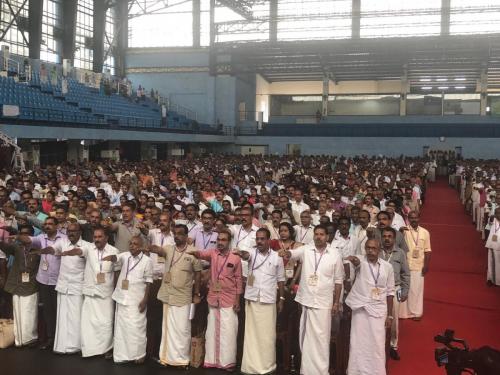
Oath-taking at the Cooperative Congress.
Work and Economic Growth, and Combating Climate Change. In addition to the formation of the Kerala Cooperative Bank, the policy recommendations include: increasing inflow of agriculture credits from 10% to 25%; the primary agricultural credit societies (PACS) continue to function as multi-service society for members and general public; recognize PACS as the official banker of Local Self-Government (LSG) and invest all funds of LSGs with Co-operative Banks and route all banking transactions through them; reorient the functioning of co-operative marketing societies so as to undertake value addition of local cash crops; develop initiatives for women and encourage female labor force participation through co-operatives; develop a positive attitude among children about co-operative movement; develop hospital co-operative society to provide all types of health services at affordable rate; utilize the tourism co-operatives for providing tourism amenities and services; and promote ventures under Section 14A of KCS Act and Rules for creating employment opportunities by mobilizing preferential capital from members offering returns up to 49 percent of the net profit of that venture. On the final day (February 12th) of the event, detailed discussions were held on the recommendations under 10 sub-sectors for preparing developmental proposals.
On February 11th, seven seminars on different topics including Kerala co-operative movement from a national perspective, Central government’s approach to the co-operative sector, co-operative education, training and research, technology-oriented and youth-friendly co-operative sector, new ideas and ventures in the co-operative sector, and strengthening human resources were presented.
The Congress ended with a colorful procession of 100,000 cooperators on February 12th. A decision taken at the Congress was to hold it every three years, instead of existing five years, to ensure periodical review of the co-operative policy. The next congress will be held in 2021.


