
The Asian Solidarity Economy Forum (ASEF) which began in 2007, aims to provide a platform for organizations and enterprises in Asia to share their social and solidarity economy (SSE) initiatives that prioritize people and planet over profit. SSE is a viable pathway to sustainable development, particularly in the rebuilding of economies in the context, and the aftermath, of the Covid-19 pandemic.
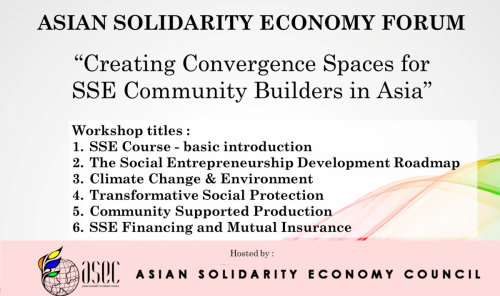
ASEF’22 was held on 26th August, under the title “Creating Convergence Spaces for SSE Community Builders in Asia.”
The 110th session of the International Labor Conference (ILC), held from 27th May to 11th June 2022, passed a resolution which enjoined member governments to, among others, value the local anchoring of SSE and its contribution to both well-established and innovative solutions to provide decent work opportunities and meet the needs of disadvantaged groups and persons in vulnerable situations, particularly women, including in rural areas; and develop an inclusive, integrated and gender-responsive approach to the promotion of the SSE, including with respect to groups in situations of vulnerability, recognizing the value of care and unpaid work.
ASEF 22 aimed to broaden awareness and deepen understanding of how SSE entities develop inclusive, integrated and gender-responsive approaches to sustainable development; and to strengthen networks of “SSE Community Builders” at the national and local levels. Participants actively participated in the following provided spaces:
1) The SSE Course, a basic introduction to the theory and practice of Social Solidarity Economy (SSE) - The workshop reviewed the course outline and deliberated on why the SSE course is important for government officials, businessmen, cooperatives, NGOs, and social enterprises.
2) The Social Entrepreneurship Development Roadmap (SEDR) - Developed by Bayan Academy and launched during the Philippine Social Entrepreneurship Summit in November 2021, the SEDR is a strategic tool for building a common understanding of social enterprises and mobilizing commitment to their development.
3) Climate Change & Environment (CCE) - The CCE workshop dealt with people’s initiatives in conserving the environment and developing local communities’ resilience to climate change. It featured the experiences of the community forest user groups in protecting, growing, & benefiting from the forests of Nepal.
4) Transformative Social Protection (TSP) - The TSP Workshop dealt with programs designed to reduce poverty and vulnerability by diminishing people’s exposure to risks and enhancing their capacity to protect themselves against hazards and interruption/loss of income. It featured the safety net measures provided by Habitat for Humanity India for the poor in India.
5) Community Supported Production (CSP) - Community supported production has risen in importance in the advent of the Covid-19 pandemic as people in quarantine zones sought to secure food supplies from local producers. Two models of CSP were featured in the workshop - the women self-help groups of ASSEFA in India and the Fair Trade experience of Dew Crafts in Bangladesh.
6) SSE Financing and Mutual Insurance (FMI) - Access to finance is important for the survival of start-ups as well as for the sustenance of growing enterprises. But there are serious constraints to banking access of SSE organisations and enterprises, many of which are micro and small in terms of business size. This workshop showcased the experiences of the Alalay Sa Kaunlaran Inc. (ASKI) in financing micro & small enterprises and in facilitating mutual insurance among poor households.
Mr. Balasubramanian Iyer, Regional Director, ICA-AP was invited to deliver a solidarity message to the ASEF 22 participants. He said that the ASEF 22 theme ‘Creating Convergence Spaces for SSE Community Builders in Asia’ fits well with the recently held General Discussion on the SSE at the ILO 110th ILC in June. Along with the definition of SSE, the ILC conclusions also include guiding principles to advance SSE and sustainable development. He mentioned the joint consultation organised by ICA-AP and ILO on “ILO Recommendation 193 and the Social and Solidarity Economy: Perspectives from the Asia-Pacific Region” to mark twenty years since the adoption of the Promotion of Cooperatives Recommendation, 2002 (No. 193). The event was a good opportunity to celebrate ILO 193, engage in a discussion on its implementation and centre thinking about the cooperative identity from the regional perspective.
The full message can be watched here.


