
By Ivjyot Singh, Program Officer, ICA-EU Cooperatives in Development People-centred Businesses in Action, ICA Asia and Pacific.
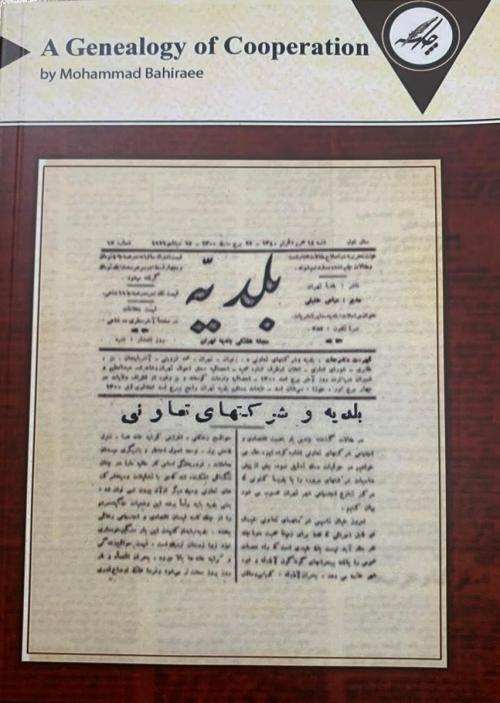
A Genealogy of the Cooperative by Mohammad Bahiraee of the Barg-e-No Research Cooperative, Iran, illustrates the rich history of the cooperative movement in Iran.
In the chapter, Problematisation of the controversy, the author sets the context by stating that the economy was a function of social relationships. The cooperative movement was marginalised from the mainstream due to the decoupling of the economy from society. He states that cooperatives exist in two different ways: one, where they have minimal association with the mainstream economy of capitalism and bureaucracy; and the other, where modern cooperatives assume capital relations and hierarchical order.
The second chapter, Collective work in a non-capitalist economy, explores the formation of Vaareh and Boneh, the two collectives in Iran. Vaareh is an informal cooperative system mainly run by women and based on collective mutual help. In this system, families owning livestock pooled their milk and set up dairy cooperatives. At each round of pooling and processing, the produce distributed. The redistribution was unique in that it was not based on the amount and quality of contributions, but on the right of the presence and participation of women who represented their families, i.e. pooling for the purpose of reproducing the group. Boneh is a collective agricultural system based on cooperation that goes beyond work, including close relationships between member families. Each collective unit had a different area depending upon the amount of water available for it. The producers were entitled to a share of produce, as were others who had either indirect or no relation to production (for example, carpenters and blacksmiths). The economy was based on production of goods for the sake of using them and not for accumulation and further profit. Excess production thus was not an issue and in the rare case it happened, non-contributors could benefit from it.
The cooperative economy stood out as one where social and economic relations were inextricably mixed, with the rejection of consumerism and tending towards redistribution in cases of surplus production.
In The advent of progress discourse, a change in the cooperative dynamic is noted, with a shift from the ‘collective’ to the ‘individual’ and consumerism. The subsistence economy was being looked down upon and the earlier concept of labour (involving engagement which didn’t necessarily associate with income) transformed to that of a job.
In the chapter, The Birth of Cooperatives and The Hatching of another type of Cooperatives, the author explores the inclusion of cooperatives under commercial law and its repercussions on the cooperative economy. Cooperatives in their natural character were not seen as useful and to be so, they had to be instrumental in wealth creation and increased production. Cooperatives then became means for the government to gather statistics and learn about rural populations. However, cooperatives without hierarchies and state experts also existed. These were economic entities which facilitated greater local autonomy. However, many of these cooperatives remained separate from other social groups, eventually becoming a capitalist haven for some privileged groups.
The final hit came to the cooperative movement in Iran came with the joining of market and state. Cooperatives were denied facilities and started competing in the open market; combined with the state-led merging of cooperatives they became more hierarchical. The book incites introspection on the cooperative movement, leaving one to wonder on how cooperatives can overcome these threats and establish themselves as mainstream, sustainable socioeconomic model.


