ICA-AP’s work with agriculture and forestry cooperatives
In 2020, we mark 60 years of ICA in the Asia-Pacific region, working hand-in-hand with our members to grow and enhance the cooperative movement. Over the years, ICA-AP has worked across many sectors and focused on key development areas such as gender equality, youth inclusion, entrepreneurship, and capacity building. This month, we highlight the work undertaken by ICA-AP and our agriculture and forestry members.
ICA-AP’s involvement with agricultural cooperatives has been central as there is high dependence on agriculture and allied activities in the region. More than 25% of ICA-AP members are directly involved in agriculture, forestry, and allied services. One of the main objectives of the establishment of the ICA Regional Office in 1960 in New Delhi, India was to assist agriculture and rural development. Agriculture cooperatives provide value to farmers’ associations and agricultural cooperatives by giving farmers stronger involvement in the value chain and increasing their market power. Agricultural cooperatives play a key part in linking farmers to markets, providing a platform for negotiating with buyers, offering products and services (marketing and processing), and delivering training, business planning and capacity building services to their members.
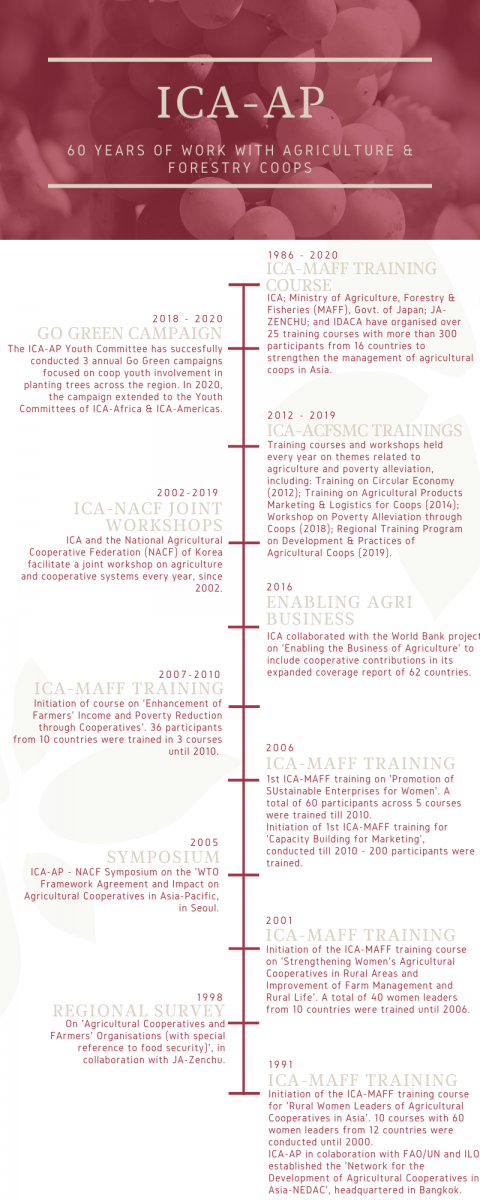
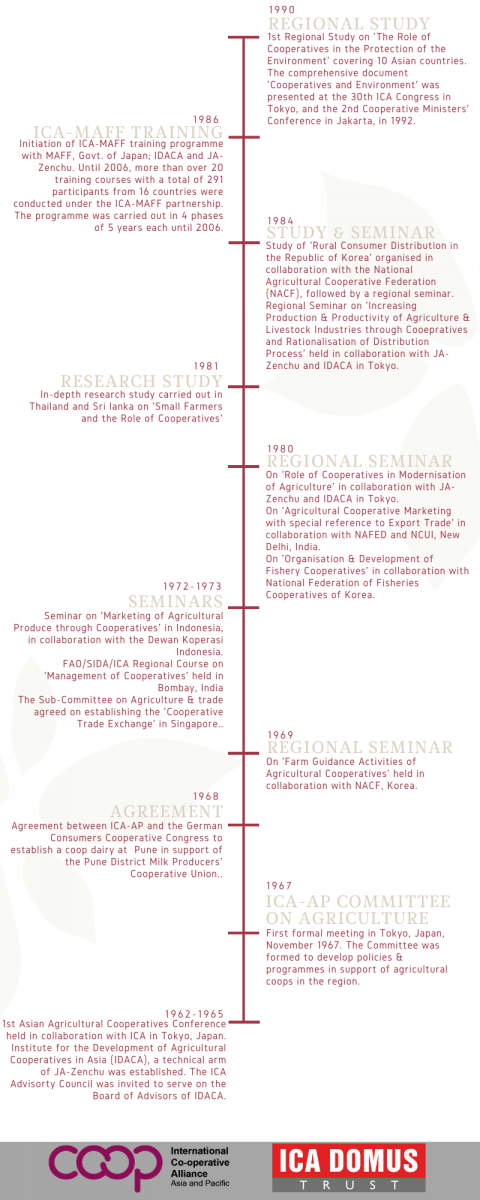
Since 1960, ICA-AP and its regional committees on Agriculture and Forestry have worked with members to improve rural, agricultural and environmental outcomes across the region. The ICA-AP Committee on Agriculture was established in 1967 and had its first formal meeting in Tokyo, Japan in November 1967. The overall aim of the Committee is to promote the development of sound and effective agricultural cooperation and to develop appropriate policies and programmes to protect and promote the interests of farmers. The activities of the Committee were financially supported by the Swedish Cooperative Centre (SCC) for many years until 1995. Over the years, the support to develop agriculture has come from the All China Federation of Supply and Marketing Cooperatives (ACFSMC), the Indian Farmers Fertilizer Cooperative Organization (IFFCO), the Central Union of Agricultural Cooperatives of Japan (JA Zenchu) and the National Agricultural Cooperative Federation (NACF) of Korea.
The ICA-AP Committee on Forestry was formed after deliberation during the Regional Board Meeting in Kobe, Japan in 2012. Up until 2012, fishery and forestry cooperatives from the region were involved with the ICA-AP Agriculture Committee. The Forestry Committee was formed in response to the global environmental and climate change threat, more acutely felt in the Asia-Pacific region due to increasing instances of climate related disasters, high deforestation, and low levels of per capita forest cover. The ICA-AP Committee on Forestry was thus formed with the aim of contributing to mitigating climate change, enhancing the socioeconomic status of people through collective action in sustainable natural resource management, afforestation of wasteland for environment upgradation, employment generation, and integrated rural development.
The ICA-Ministry of Agriculture, Forestry and Fisheries (MAFF), Government of Japan training courses have been one of the longest standing training programmes in the region. They started in 1986 and are still ongoing! The training course on “Strengthening Management of Agricultural Co-operatives in Asia” was “to help strengthen and improve agricultural cooperatives’ performance in the Asia region in order to bring about a qualitative and quantitative improvement in services to member-farmers at the grassroot levels. At the end of the 20th training course (2005-2006), 291 participants from 16 countries consisting of senior to middle-level managers responsible for the agricultural cooperative development, both men and women, had successfully participated in this program.
Following this, a training course on “Enhancement of Farmers’ Income and Poverty Reduction through Cooperatives” had been developed and agreed upon for implementation through the ICA in 2006, with focus on the strengthening of farm guidance methods, joint collection, shipment, safety and improvement in the quality of farm products aimed at increasing farmers’ income as a new development for the training course. Under this project, five Training Courses on “Enhancement of Farmers’ Income and Poverty Reduction through Cooperatives” were held between 2006 and 2010, with 12 participants in each course.
The training course on “Fostering Core Leaders of Agricultural Cooperatives” was developed and agreed upon for implementation through the ICA for three years, between 2011 and 2013, to assist fostering of the core leaders of agricultural cooperatives, who were expected to play leading roles in agricultural cooperatives and farmers’ groups that would contribute to the improvement of agricultural production and income of the farmers in the Least Developed Countries (LDCs) of Mekong River countries, ASEAN and the South Asian Countries.
On completion of last training course in the above series in 2013, it was decided by MAFF to extend the above training course for another three years – 2014-2016 under the overall “Japan (MAFF)-ASEAN Project on “Strengthening Capacity Building of Developing Countries in Asia.” After successful completion of the last training course in the above series, the MAFF decided to introduce a new project entitled “Capacity Building for Asian and African Regions” under the Government’s ODA Program. The term of the project would be three years (2018 to 2020).
In these training during the last 34 years, the participants have produced several grassroot development project proposals in the agricultural cooperative sector “aiming at enhancing the participation and income of grass-root level farmer-members.” A number of these projects have already been implemented successfully in many countries. The trainings have benefited not only countries in Asia but also in Africa. Through the trainings, partnerships have been established with a number of institutions: Central Union of Agricultural Co-operatives of Japan (JA-ZENCHU); Cooperative Institute of Malaysia (CIM); Cooperative League of Thailand (CLT) / Cooperative Promotion Department (CPD), Bangkok, Thailand; Fertilizer Management Development Institute (FMDI) of IFFCO, New Delhi, India; Institute for the Development of Agricultural Cooperation in Asia (IDACA), Tokyo, Japan; and the Institute of Rural Management, Anand (IRMA), Gujarat; India.
Over the years, ICA-AP has conducted a variety of research projects, training programmes, workshops and conferences in relation to sustainable agriculture, circular economy, climate change, development of farmers’ organizations, and the environment.
The timeline below provides a brief glimpse into the initiatives undertaken in the region: