
July 6 was observed and celebrated as the 97th International Cooperative Day (Coops Day) and the 25th United Nations International Day of Cooperatives! Every year this day is a reminder of the power of cooperative enterprises and their vital contribution to the social, economic and political empowerment of people from around the world. The theme this year was ‘Coops for Decent Work,’ as a testament and support of the Sustainable Development Goal 8 (SDG8) - ‘Decent Work and Economic Growth.’ The theme is also relevant as the International Labour Organization is celebrating its centenary year with a special focus on the ‘future of work’. Cooperatives help reduce inequality, provide job security, and combat high unemployment levels, especially for youth and other vulnerable groups. Cooperatives employ close to 250 million worldwide and reman resilient in times of financial distress. They are truly the ideal mediums to achieve decent work for all.
Cooperatives enthusiastically celebrated the Day in their own unique way. The National Cooperative Union of India (NCUI) and the ICA-AP organized a Seminar on the theme of Coops for Decent Work. NCUI also organized a theme-based painting competition for young children.
Mr. T.K. Kishor, Program Director, ULCCS, gave an insightful presentation about how ULCCS contributes to each of the 17 SDGs. For example, ULCCS sets up a health camp every six months for its workers (SDG 3), 65% of its engineers employed are women (SDG 5), and the wages earned by the workers is higher than the industry average (SDG 8). Mr. Sung Chang Hong, Managing Director, The Nonghyup Bank (NH Bank) shared that NH Bank was established by the National Agricultural Cooperative Federation of Korea (NACF). NACF represents 2.3 million farmers and 100,000 cooperatives. Mr. Hong said that the Governments of India and Korea had collaborated to set up the Bank in India in 2016. In the long run, NH Bank hopes to contribute to rural development in India. Ms. Mirai Chatterjee, Chairperson, SEWA Cooperative Federation, shared the inspiring and humble beginnings of SEWA Bank by a group of 40 rural women with little to no education. Today the Bank has grown by leaps and bounds, empowering millions of women. She shared the journey of SABINA, their first handicraft artisan cooperative, which was established from the struggles of women labourers demanding fairer wages in the garment industry in Gujarat, India! Ms. Chatterjee said that women’s cooperatives offer decent work and income, are inclusive, decentralised and closer to women’s homes, ensure leadership for women, and above all are ‘laboratories for democracy’. Mr. Satoshi Sasaki, Deputy Director, ILO India, shared that ILO has had a long-standing partnership with the Committee for the Promotion and Advancement of Cooperatives (COPAC). He said that today the main challenges faced by those working towards labour rights are child labour, modern slavery and forced labour. One important way forward is the formalization of the vast numbers of workers in the informal sector. Cooperatives provide such an avenue leading to decent work opportunities. In the emerging gig economy, cooperatives can find their space through digital platforms. Mr. Mohit Dave, Program Manager, ICA-AP, presented the findings from the ICA-AP & CICOPA Study of Industrial and Service Cooperatives in Asia Pacific region. The main recommendations from the Study include i. introduction of appropriate legal frameworks with clear definitions, ii. Specification of worker-member status, iii. Closely monitoring against misuse and abuse, iv. Reasonable minimum number of founding members, amongst others. The full version of this Report will be made available soon.
NCUI presented eco-friendly tokens of appreciation to the speakers in the form of house plants that used coir pith. Coir pith is a spongy material that binds the coconut fibre in the husk. It is an excellent soil conditioner and has moisture retention qualities, contributing to water conservation!
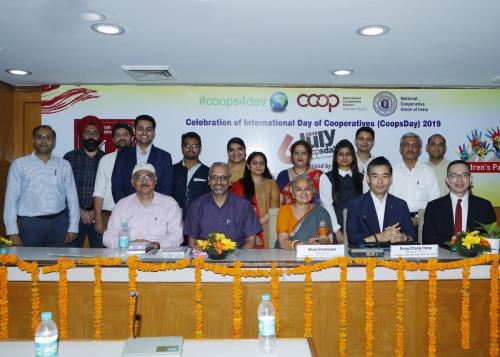
Panellists, ICA-AP and NCUI staff at the closing of the Seminar.
The Cooperative Department of Myanmar organized a ceremony commemorating the International Day of Cooperatives. H.E. Hon’ble Vice President U Henry Van Thio graced the ceremony and urged the cooperative societies to prioritize the development of their communities, emerge as just workplaces, and contribute to nation-building. The ceremony recognized the exemplary work of cooperatives and presented them with awards. Loans for cooperative development were also presented to some cooperative societies. A sales exhibition was also set up for cooperatives to display and sell their products.
The National Cooperative Federation of Nepal (NCF) co-organised a Seminar with the Ministry of Land Management, Cooperatives and Poverty Alleviation and UNDP. The Hon’ble Minister for Cooperatives, Ms. Padma Kumari Aryal, stated that the future of cooperatives hinges on their ability to provide entrepreneurship development, youth inclusion and decent work opportunities. Cooperatives from all seven provinces were awarded with the ‘Excellent Cooperative Award’ and ‘Excellent Cooperative Business Awards’ for their performance, effectiveness, and contribution towards decent work throughout the year. NCF also distributed office equipment to 10 district cooperative unions for their capacity enhancement under the strengthening cooperative program. Ms. Ayshanie Medagangoda-Labe, Resident Representative, UNDP Nepal applauded the Constitution of Nepal for recognising cooperatives as one of the pillars of economic development. She mentioned that UNDP has been closely working with more than 500 cooperatives at various levels and is ready to work with them in the future as well.
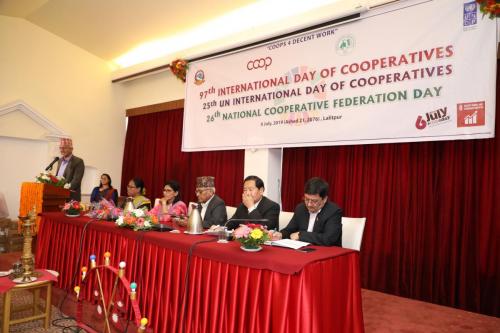
Speakers at the Seminar organized by NCF.
In a press release issued by the Business Council of Cooperatives and Mutuals (BCCM), CEO Ms. Melina Morrison stated that “there were many ways coops and mutuals support decent work for everyday Australians citing the policy of mutual banks and credit unions to not offshore call centre jobs and the emergence of cooperatives owned by workers in the recycling, green manufacturing sectors, disability and aged care and a new taxi cooperative where drivers have united to provide local competition to Uber.” BCCM also launched a video for the updated Get Mutuals cooperatives’ resource site. Get Mutual is a resource for cooperatives and mutuals looking to start a coop or mutual and existing coops and mutuals seeking to strengthen or grow. It offers online resources, a constitution builder and other tools, and links to advice and training options.
Mr. Craig Presland, CEO, Cooperative Business New Zeland (CBNZ), wrote an article on the theme of Coops Day, titled ‘The Essential Role of Co-operatives in the Future of Work’. He made reference to the Report of the Global Commission on the Future of Work. The Report acknowledges cooperatives for their contribution to gender equality (SDG 5), and the emergence of worker cooperatives as a way to improve the situation of workers in the informal economy. Mr. Presland notes that ‘the report provides an opportunity to reflect upon how cooperatives can contribute to creating a brighter future and deliver economic security, equal opportunity and social justice.’ He mentions that the Report, among other things, talks about the correlation between climate change and the world of work. In this regard, Mr. Presland includes the ways by which the cooperatives in New Zealand are protecting the environment including; ‘fencing to keep livestock out of rivers and waterways; improved on-farm systems in the treatment and discharge of effluent; reduction in on-farm carbon emissions; reduction in the burning of fossil fuels; more efficient use of energy; the emergence of “clean” energy in the form of solar and wind power’ etc.
The Singapore National Cooperative Federation (SNCF) celebrated Coops Day by organizing the third edition of the Bicentennial Pop-Up Art Event. The event showcased art installations on the theme of "Coming Together As One Through Art.." It featured ways in which NTUC cooperatives have impacted Singapore through the years and still continuing to improve the lives of people in Singapore, by managing the cost of living, increasing affordability and accessibility of daily necessities. The Event also included activities like ‘test your creativity,’ where visitors taking the most creative photographs at the installation received cash prizes!
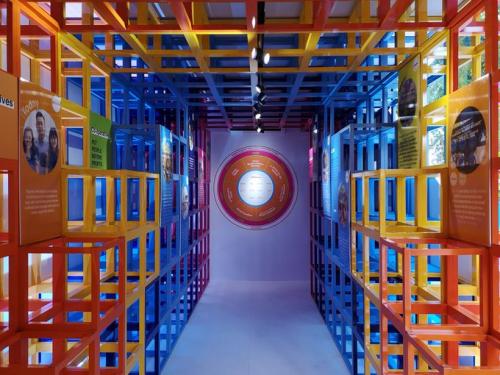
At the SNCF Bicentennial Pop-Up Art event.
The Iran Chamber of Cooperatives (ICC) organized an event addressed by high-level dignitaries including Dr. Dezhpasand, the Minister of Economic Affairs and Finance of Iran. Dr. Dezhpasand said that there is an urgent need for export-oriented cooperatives and for public cooperatives that are strong enough to compete at the stock markets. ICC unveiled its ‘Intelligent System for the Distribution of Essential Goods’ or MAHTA, which is an efficient way of connecting the value chain of cooperative products from the beginning till the end. Every step of the distribution can be monitored through this application. ICC also launched its ‘Database of Iran’s cooperatives’ or BATA, providing latest updates on the changes in the cooperatives including the Board of Directors, and products and services. MoUs were signed between the different ICA members in Iran. The ICC, Rah-e Roshd, and Barg-e No launched a book titled ‘Genealogy of Cooperatives in Iran.’ A short video capturing the celebration can be viewed here.
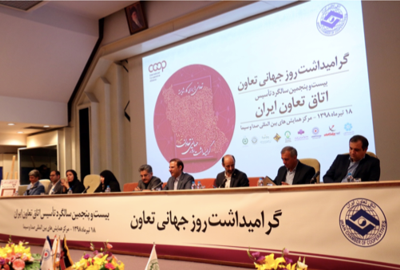
During the panel discussion on Coops for Decent Work. Image credit: ICC


