
ICA-AP and ICA Africa in collaboration with the Ministry of Tourism, Air Transport, Handicraft and Social Economy, Kingdom of Morocco and with support from the ICA-EU Partnership organized the 1st Co-operative Development Conference for the Middle East and North Africa (MENA) aimed at fostering co-operative partnerships to enhance collective action on SDGs. The conference was organized in Marrakech, Kingdom of Morocco from February 4 to 6, and attended by 104 participants from nine countries.
The objective of the conference was to enhance awareness and engagement of stakeholders in the MENA on SDGs, develop networking among cooperatives, and increase interactions with CSO networks to foster multi-stakeholder partnerships for development. The participation of Arab NGO Network for Sustainable Development, African Network of Social and Solidarity Economy, Association of Environmental Education for Future Generations, Euro-Mediterranean Network of Social Economy (ESMED), European federation of renewable energy cooperatives (RESCoop), and International Labour Organisation helped broaden dialogue with all stakeholders. The participation of ICA members from Japan, Jordan, Malaysia, Morocco and Palestine, and CSOs/Government representatives responsible for cooperatives from Saudi Arabia, Tunisia and Lebanon, helped develop networking among cooperatives in the region.
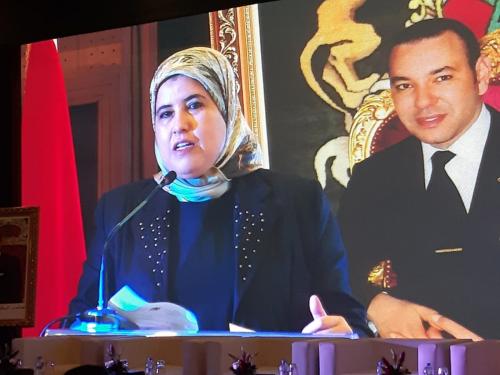
Mrs. Jamila El-Mossalli, Secretary State of Handicrafts and Social Economy, Government of Morocco.
Mr. Japheth Magomere, President of ICA Africa set the tone of the conference by providing the rationale for regional integration and the relevance of enabling instruments. The cooperative movement in the region has the capability to address issues relating to and measure such as the indicators of economic growth, the rate of unemployment and demographic dividend of the cooperative movement in the region. H.E. Mr. Mohamed Sajid, Honourable Minister, Ministry of Tourism, Air Transport, Craft & Social Economy, Government of Morocco informed the participants about the development of cooperative movement in Morocco and its active role in nation building. Mrs. Jamila El-Mossalli, Secretary State of Handicrafts and Social Economy, Government of Morocco elaborated on the constitutional law 112-12 which provides an enabling environment for the formation of new cooperatives and operations of existing cooperatives (over 20,000 with more than 600,000 members).
Dr. Sifa Chiyoge, Regional Director, ICA Africa welcomed the delegates and touched upon ICA’s priorities in with members in Africa while discussing the ICA-EU partnership. Mr. Balasubramanian Iyer, Regional Director, ICA-AP apprised the participants on the contribution of cooperatives in the Asia-Pacific towards Agenda 2030 and in involving youth. Mr. Hüseyin Polat, ex-Professor of Cooperative Management and Training at the ILO discussed the various initiatives undertaken by ICA towards strengthening engagement with cooperatives in the MENA region and advocating the ILO recommendations 193. He also presented statistics and experiences of the social economy in the Maghreb countries.
In order to enable participants to experience cooperatives in Morocco, field visits were organized to the Center for Rehabilitation and Training of Traditional Crafts in Marrakech and the Al-Olfa cooperative for cheese production and marketing in Al-Haouz District. The conference dedicated two days for discussions on key areas of interest for the cooperatives in the MENA countries: legal and political environment for the development of cooperatives; identify emerging trends in the fields of renewable energy, services and education; promote C2C trade; and the role of CSOs to protect the environment and ensure the rights of marginalized people.
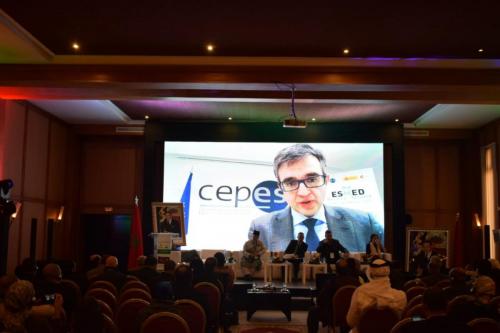
Mr. Carlos Lozano, Secretariat of the Euro-Mediterranean Network of Social Economy.
The conference helped underscore the need for co-operative federations to work closely with the ICA to leverage synergies of global partnerships and economies of scale. The governments in the countries of MENA region need to take cooperatives into account by carrying out consultations with the sector when developing economic policies and regulations and creating legal frameworks. The cooperative sector deserves equal treatment with other economic sectors, in as much as cooperatives have their distinctive structure that are member-driven, well integrated in communities and built from the ground up. In terms of next steps, the organizers will leverage the findings from the conference to promote an environment for cross-border support with increased ICA membership in MENA and enhanced efforts towards achieving SDGs.


