
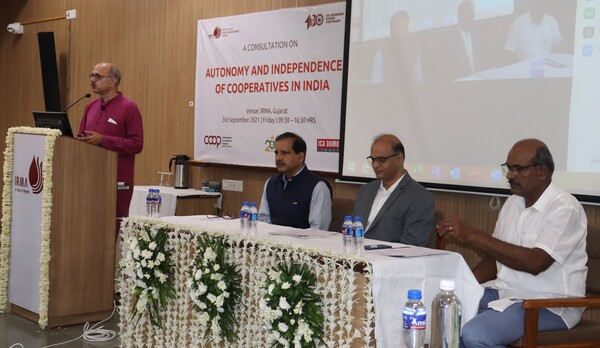
The Institute of Rural Management Anand (IRMA), India in collaboration with ICA-AP, ICA Domus Trust (IDT), and Andhra Pradesh Mahila Abhivruddhi Society (APMAS) organized a multistakeholder consultation on “Autonomy and Independence of Cooperatives in India” on 3 September 2021. It discussed prospects for the cooperative sector, considering the current political economy. The consultation gave space to share the different views and experiences of the panellists and brought forth an Anand declaration, containing a brief set of actionable policy recommendations.
The opening remarks were shared by Prof. Umakant Dash, Director, IRMA; Dr. C. Shambu Prasad, Professor, IRMA; Mr. Balasubramanian Iyer, Regional Director, ICA-AP and Mr. C.S. Reddy, CEO, APMAS.
Prof. Dash noted the role of cooperatives in reducing inequality and Dr. Verghese Kurien’s legacy in forwarding the cause of their autonomy and independence. His address was followed by a brief introduction to the theme by the representatives of ICA-AP and APMAS. They not only reminded the participants of the work done by the veterans like Dr. Verghese Kurien and Mr. Rama Reddy in India but also various international declarations and ideas calling for the autonomy of cooperatives.
While the future of the cooperative sector is uncertain in India, with the new developments in the policy sphere, the speakers in the introductory session felt that these changes also present opportunities to bring together diverse perspectives in the sphere of cooperatives.
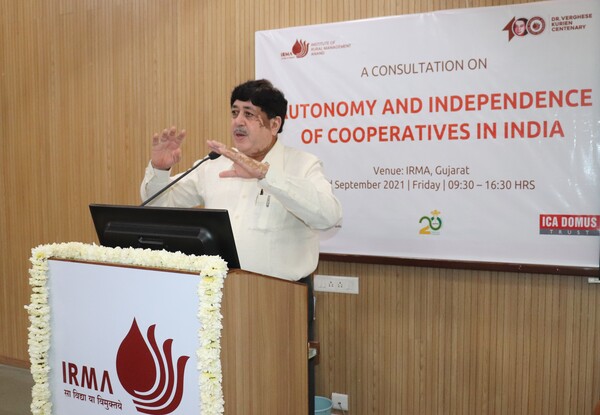
Mr. Dileep Sanghani, President, National Cooperative Union of India (NCUI), Mr. Rakesh Kapur, Joint Managing Director, Indian Farmers Fertiliser Cooperative Limited (IFFCO) and Mr. Suresh Prabhu, Founder, Cooperative Development Forum delivered the keynote address.
Two recent policy decisions have given new impetus to rethink and rejuvenate the cooperative movement in India. In July 2021, the Government of India constituted an independent Union Ministry of Cooperation (MoC) to provide a separate administrative, legal and policy framework to strengthen the cooperative movement. Independently, the Supreme Court of India struck down provisions in the 97th Constitutional Amendment Act (CAA) in longstanding litigation that impinged on the role of states and declared that cooperative societies as a subject matter belong "wholly and exclusively to the State legislatures to legislate upon."
Central to both the decisions is the issue of the ‘autonomy and independence’ of cooperatives. The keynote speakers appreciated the role of cooperatives in creating greater opportunities for the marginalized sectors and considered the autonomy of cooperatives essential for their survival. They opined that the role of the government is to provide safety nets, both for the producers and consumers organized in a cooperative mode in case of market failures. Some participants argued that the union ministry of cooperation will be playing a major role in pushing forward the ideals of the 97th amendment. The important role of cooperatives in every sector was mentioned, along with the limitations under present regulatory regimes. The speakers envisioned that the new ministry will be able to mitigate these challenges, along with taking the sector in the right direction and mentioned the need for streamlined regulations.
Panel Discussion 1 – Speakers: Mr. Meenesh Shah, Chairman, NDDB; Dr. Thomas Isaac, Economist, Kerala; Mr. Jaya Prakash Narayan, Founder President, Lok Satta; Mr. T. Nanda Kumar, Former Secretary, Department of Agriculture, and ex-Chairman IRMA and NDDB; Mr. Rama Reddy, President, Cooperative Development Foundation; Mr. Ravinder Rao, National Federation of State Cooperative Banks limited (NAFSCOB); and Sh. Mangaljeet Rai, Chairman, National Dairy Cooperative of India (NCDFI)
Facilitator – Dr. C. Shambu Prasad
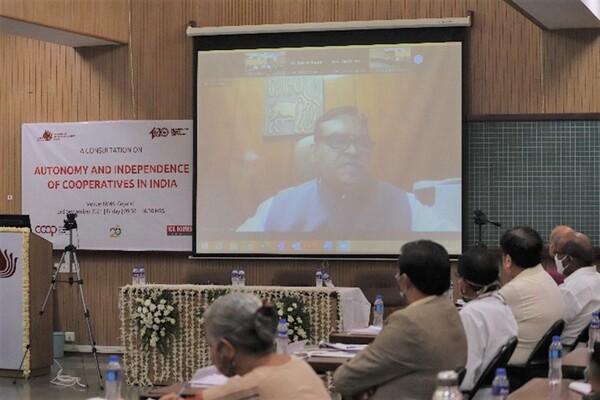
The 97th CAA in 2012, conferred a fundamental right on the formation of cooperatives. In 2013, the Gujarat High Court decreed that Part IX B, which impinged on the rights of states, was ultra vires. The Supreme Court, based on an appeal by the government, recently upheld (though partially) the view of the Gujarat High court holding Part IX B of the Constitution as ultra vires. Incidentally, the judgement came on an appeal by the Union of India against an order passed on public interest litigation (PIL) by an individual. None of the state governments was party to the proceedings. It is now to be seen whether state governments decide they would like to retain or not the amendments made in their cooperative Acts under the 97th CAA and the role the MoC would play in bringing them to make changes in the Acts.
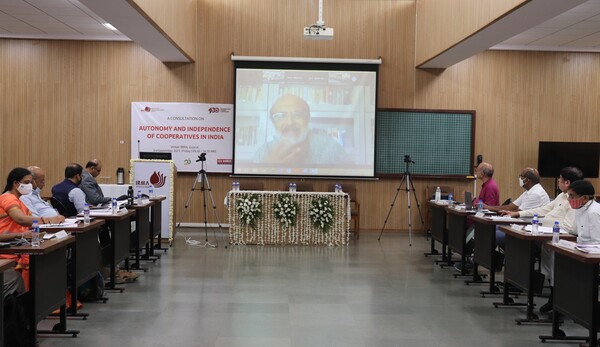
One of the speakers was largely enthusiastic about the new developments in the cooperative policies, as it might help to reduce regulatory ambiguities and believed that it would lead to greater operational independence. Some speakers were staunchly opposed to the idea of framing a national level cooperative policy. They argued that the framework can undermine the capacity of successful cooperatives in Gujarat and Maharashtra to operate and might be used for securing the vested interests of certain actors. Their discussion brought out important aspects of how the cooperative sector in India has been part of the governmental vision of development in India, which made the question of autonomy integral to the sector from its inception. While it meant autonomy of state governments to frame the cooperative policies in the respective states for some, for others it meant autonomy of citizens. And in that regard, all speakers agreed that the financial independence of the cooperatives is essential for breaking out of state interference. However, in the absence of member capital, it is difficult to avoid government grants, which translates to their interference.
While some considered it unfortunate that the 97th Amendment act had been struck down on procedural grounds, others believed it should have been struck down on grounds of violating fundamental rights, along with the procedural inconsistencies.
Speakers described how other regulatory regimes like the Banking regulations act can also pose a threat to the autonomy of cooperatives, and therefore they expected the MoC to encourage the cooperative spirit in handling the diverse range of cooperatives and their specific needs. The panel also highlighted the regional diversity and the importance of added efforts to promote cooperatives in resource-poor regions like the North-East where the cooperative sector is not so well developed.
Panel Discussion 2 – Speakers: Mr. Santanu Mohanty, Independent Consultatnt; Ms. Mirai Chatterjee, Chairperson, SEWA Coop Federation; Mr. C.S. Reddy, and Mr. V. Vivekanandan, Director, FishMARC, Vrutti
Chair: Mr. Balu Iyer
The discussion underscored that the experiences from the field can help understand the context within which they operate, i.e., how can the policy change to mitigate the challenges faced by the cooperative sector.
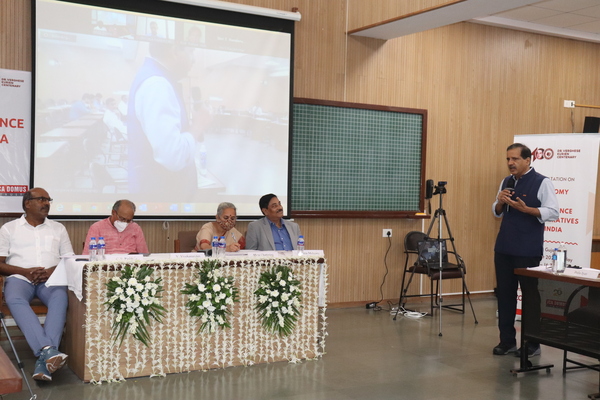
The experience of a pilot project from Odisha explained how it is essential for the government to proactively promote cooperative institutions like PACS at the grassroots along with SHGs through collaboration with the Ministry of Panchayati Raj, Rural Development, etc. This was seen as crucial for the cooperative movement to take off and capture the imagination of the population, especially the youth who do not participate in these institutions. It was also noted that a sense of cooperatives can be inculcated through the education system from a very early age, a practice that exists in various countries.
The experience of other civil society organizations also established the importance of cooperatives in reducing the vulnerabilities of marginalized communities, especially in the light of the rise of a gig economy and the COVID-19 lockdown. The cooperative societies based on the principles of mutual trust have been able to undertake the welfare functions much better providing security to their members. They have been able to provide insurance and other social security functions. The organizations have promoted cooperative micro and small enterprises and created a support system for them. Whether they are based on SHGs or worker’s unions, the examples here have been of women-led institutions, which tries to acknowledge the conspicuous absence of women in traditional cooperatives across the country. However, they pointed out related policies like the central sector scheme for promotion of FPOs, although having the integral spirit of cooperation, are used to undermine cooperatives.
While the liberal cooperative organizations play a crucial role in creating innovative models like staggered retirement of board members and are very independent, it was pointed out that they end up playing a very limited role in mobilizing communities around policies. One of the speakers reflected that this is because the primary stakeholders of cooperatives, that is the members, lack a sense of ownership. Apart from this the panel also asserted that data and evidence on cooperatives are difficult to retrieve and therefore inhibits the ability to provide actionable policy recommendations.
The panellists discussed how the welfare functions of cooperatives allow bureaucrats and politicians to take over cooperatives. Voluntary membership is compromised because cooperatives go out of their way to register members under cooperatives, while the commercial aspect of cooperatives is ignored. The example of fish cooperatives in South India brings out this aspect. In the same vein, one can see how the over-reliance of civil society actors on government can ultimately lead to them implementing the schemes of the government, using the cooperative institutions they promote as a tool for implementation.
Anand Declaration – Facilitators: Dr. C. Shambu Prasad, Mr. C. S. Reddy, and Mr. Mohit Dave, Program Manager, ICA-AP
The multi-stakeholder consultation with cooperators, practitioners, academicians, and experts in the sector examined the legal and constitutional implications of these decisions and explored how future initiatives on cooperatives can embed the autonomy of the cooperative sector and make it vibrant. The consultation reflected on what ails the cooperative sector today and made a few policy recommendations for enabling the much needed ‘ease of doing business’ that could inform and engage the new MoC. In this regard, a declaration is under preparation and will be released soon.
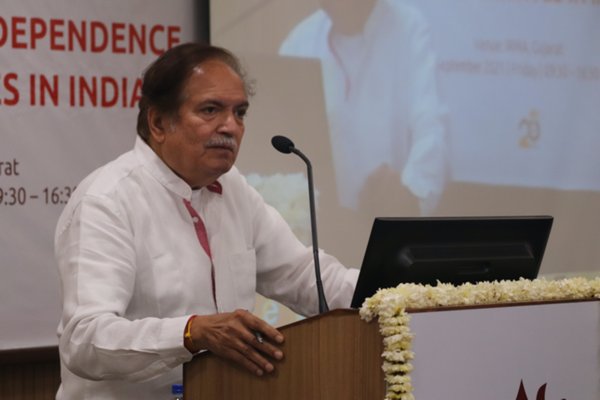
Dr. Tushaar Shah, Professor Emeritus, IRMA, in his closing remarks, argued that while autonomy and independence are essential for cooperatives, they may not be sufficient for a thriving cooperative sector. He opined, if the cooperative sector might be able to pull more resources and weight behind them, they will be in a better position to gain autonomy, as the case of Amul has depicted. While it is important to bring out a statement like the Anand Declaration on the autonomy of cooperatives, it will be important to look at the more complex issues of cooperative development like scale and member centrality.
Other participants felt that such scale and vertical growth can extinguish solidarity among members, which is why lateral growth, like in the SEWA model can be adopted. Participants also pointed out that a partnership between state and civil society would be required rather than separating the two. A convergence of interests should be there rather than trumping the state through a large-scale cooperative institution.
The consultation was successful in bringing together academicians and development practitioners from across India to deliberate upon the autonomy of cooperative enterprises, legal frameworks for an enabling environment, and the way forward for policymakers.


