
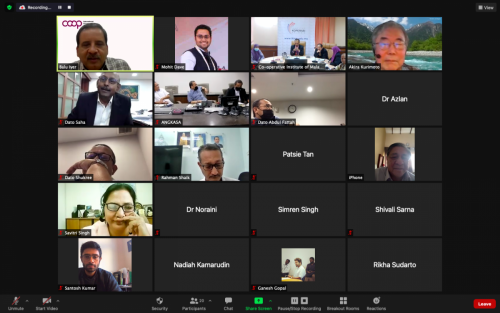
The third consultation on the Statement of Cooperative Identify (SCI) was held online on 25th March with members of the ASEAN Cooperative Organisation (ACO) to discuss the extent to which they had put the cooperative principles into practice and what progress, or the lack thereof had been achieved as a result.
Prof. Akira Kurimoto, member of the ICA Principles Committee and Chair of ICA-AP Research Committee joined the consultation to advise and guide the participants during the discussions. In his opening remarks, he highlighted how SCI can be used to evaluate cooperatives, how it sets cooperatives apart from other membership and value-based business enterprises, how it fosters member interest and responsibilities, how it enhances the effective ‘cooperativeness’ of their organisations, and how it helps build relationships with government and stakeholders.

In Singapore, not many in the Government are aware of cooperatives. The Government is also the regulator and hence the Singapore National Cooperative Federation (SNCF) works closely with the Government to advocate better regulation. SNCF has come up with various initiatives such as CREATHON – a business competition that provides a platform for local enterprising youth to collectively come up with innovative solutions addressing socio-economic challenges facing Singapore. Community, energy conservation, education, and cooperative platforms have recently gained traction in the country.
In Malaysia, ANGKASA as the apex organisation has not engaged much in the Social and Solidarity Economy (SSE) environment/dialogue. They had engaged with social enterprises when they were defined as Small and Medium Enterprises (SMEs). Now, any organisation can be classified as a social enterprise as per the Malaysian Global Innovation & Creativity Centre (MaGIC). ANGKASA is trying to get cooperatives defined under MaGIC’s classification to further promote cooperatives.
ANGKASA sees a role for itself to promote cooperatives as the best SSE organisation (SSEO) and bringing them in to implement SDGs. The Malaysian government, both at the national and local level, is increasing support to other SSEOs by enabling their formation (e.g., ease of registration and number of persons required to set up other SSEOs) and making it easy to raise resources (from the government and private sector). Cooperatives, therefore, need to ensure they are provided with a level playing field (to raise resources and form new age cooperatives) and also reach out to include others in their fold.
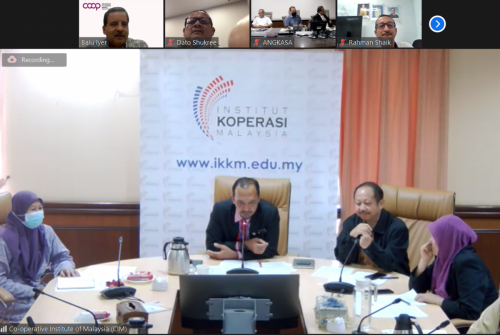
Cooperative Institute of Malaysia (CIM) as a training institution tailors the training programs to suit the government's needs. The government of Malaysia is trying to promote cooperatives and see coops as tools for socio-economic development. CIM also engages with ministries for agriculture, youth, and women to spread awareness about cooperatives. It aims for continuity in coop education from schools to universities and later in the professional work environment.
The school cooperatives play an important role in forming young entrepreneurs in Malaysia. By allowing schools to involve in business and entrepreneurial activities, members in Malaysia hoped that this will strengthen the economy and the local community, enabling it to strive for a better society. They strongly believe that developing human capital is one of the key elements of the success of the cooperative movement. An innovative Malaysian school was also featured in a documentary by aroundtheworld.coop, that looked at how young people are taught about cooperative principles from an early age.
The consultation concluded with a discussion around the contribution of cooperatives to the GDP of a country. It is very difficult to determine how to support or aid cooperative development without reliable data on the size and impact of cooperatives. ACO Members stressed that clear, concise, and reputable data on the number of cooperatives regionally and nationally like their number of members/clients, turnover, employees, and assets did not exist. The members agreed that a comprehensive database on cooperatives needs to comply and that data should be considered a start, not the definitive count.
The consultation was very useful to get a perspective on the application of the SCI, the challenges seen in practice, and the directions going forward. The COVID-19 pandemic has reinforced the need for models that strengthen the real economy and has shown the relevance of the cooperative model.


