
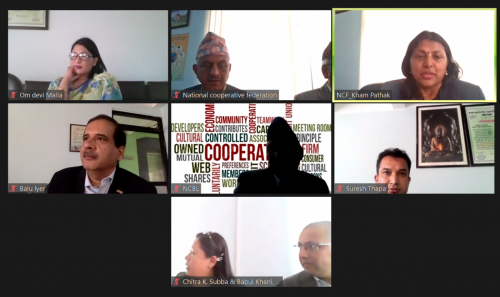
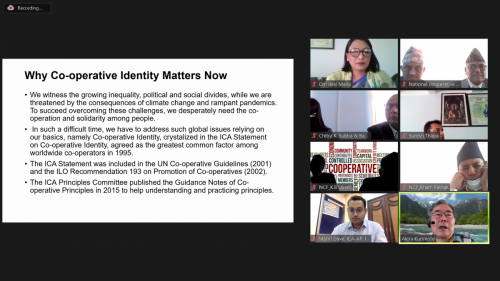
The ICA-AP regional office continued with its series of consultations on Cooperative Identity. The consultation held online on 13th April with ICA members in Nepal discussed how the ICA Statement on Cooperative Identity (SCI) guides their day-to-day operations and how they put the cooperative principles into practice, and what progress or the lack thereof had been achieved as a result. Ms. Om Devi Malla, ICA Global Board member and member of the Congress Advisory Committee, and Prof. Akira Kurimoto, member of the ICA Principles Committee and Chair of ICA-AP Research Committee also joined to advise and guide the discussions.
In Nepal, COVID-19 has put both lives and livelihood at risk. The National Cooperative Federation of Nepal (NCF) appealed to cooperatives at all levels to provide digital services to their members wherever possible to maintain social distance guidelines. The NCF has created a Corona Prevention Fund to support the Corona Control Cooperative Center and the Coronavirus Infection, Prevention, Control and Treatment Fund established by the Federal Government.
Nepal Agriculture Cooperative Central Federation Limited (NACCFL), an umbrella organization of agricultural cooperatives, has been involved in the marketing of vegetables produced in rural areas. Before this pandemic, NACCFL had three outlets that were selling only non-perishable products (pulses, cereals, different flour, honey, butter, fruits etc.). Due to the COVID-19 outbreak, NACCFL has also initiated to market the vegetables. With the support of its member organizations, NACCFL has been selling fresh vegetable at 11 places in Kathmandu valley. Under the slogan “rural products in urban areas”, NACCFL is working in the front line trying to promote cooperative to cooperative (C2C) business.
Cooperatives are also providing ambulance services to COVID-19 infected patients and free PPEs to security personals in different provinces. Additionally, Nepal Federation of Savings and Credit Cooperative Union Ltd. (NEFSCUN), Nepal Multipurpose Central Cooperative Union Ltd. (NEMCCU), National Cooperative Bank Ltd. (NCBL), including other central and district level cooperative unions offered service delivery and support to their members. Members believe that if cooperatives exemplify values and principles in their operation and in projecting their brand, they can attract more and more young people into membership.
Cooperatives in Nepal function with the guiding philosophy of group principle, self-help development and institutionalization of networks at the grassroots level. Many financial cooperatives are reducing their interest rates to help members manage their finances during the pandemic. However, the services they offer are vulnerable. Withdrawal rates are high, and a significant number of small financial cooperatives are at risk because of the financial disparity. Financial cooperatives that do not offer online service platforms or ATMs are providing door-to-door services to members who need quick access to funds and are also offering more flexible terms for loans.
Nepal’s cooperative legislation is perceived well by the movement. The Cooperative Act, 2017 was made in consultation with the cooperative federations. Chapter 13 of the Act includes certain concessions and benefits provided to cooperatives and Section 2 of the act refers to the ICA principles of cooperative identity. However, provisions should be there to advance the cooperative model through the principle of self-regulation and not punishment. The Act needs to be amended to include social cooperatives as well.
Lastly, cooperative identity in Nepal is deemed to be not always apparent in practical application, for instance, in the business practices of cooperatives. They work for socio-economic development with the strong policy of being non-political and unbiased with no discrimination of any kind on religion, caste, and gender basis. Evidence suggests that the emphasis on “selling” cooperative products and services (eg. loans) and the accompanying benefits has led to members thinking of themselves more as borrowers rather than as responsible owners. If cooperatives follow the identity statement which emphasizes on “centrality of membership,” they can protect their membership in general and the most vulnerable among them, in particular.
The consultation was very useful to get a perspective on the application of the SCI, the challenges seen in practice, and the directions going forward. The COVID-19 pandemic has reinforced the need for models which strengthen the real economy and shown the relevance of the cooperative model. It has opened new areas for cooperatives to venture into, in service of existing members, and to attract new members. The input provided by members will be presented to the World Cooperative Congress and will be used to develop a plan of action.


