
The ICA celebrated its 125th anniversary and the 25th anniversary of the Statement of Cooperative Identity in 2020. Both these landmark achievements were to be celebrated with enthusiasm at the 33rd World Congress in Seoul in 2020. Unfortunately, the COVID-19 pandemic derailed the plans. The ICA now plans to celebrate the World Congress in 2021 with the theme, ‘Deepening the Cooperative Identity’.
At the ICA-AP regional office, we are holding a series of consultations in 2021, with members to reflect on how the Cooperative Identity guides day-to-day operations (practical challenges and strategies to overcome them); how it is used to evaluate cooperatives (how it sets cooperatives apart from other membership and value-based business enterprises); how it fosters member interest and responsibilities; how it enhances the effective ‘cooperativeness’ of their organizations; and how it helps relationships with government and stakeholders. The inputs derived from these consultations will be presented at the Congress and will be used to develop a plan of action. We are delighted to have Ms. Om Devi Malla, ICA Global Board member as well as a member of the Congress Advisory Committee, and Prof. Akira Kurimoto, member of the ICA Principles Committee and Chair of ICA-AP Research Committee to advise and guide us during the discussions.
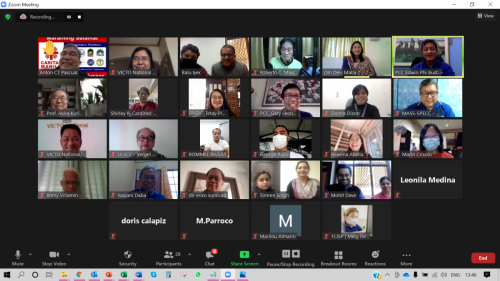
The first consultation was held online on 16th February with members in the Philippines. Many cooperatives in the Philippines display the Statement of Cooperative Identify (SCI) in their offices. However, SCI is not always apparent in the business practices of these cooperatives. Prospective members are required to go through the pre-membership education seminar (PMES) before being accepted as members. SCI is usually included in the PMES. Anecdotal evidence suggests that the emphasis on “selling” cooperative products and services (eg. loans) and the accompanying benefits during the PMES has led to members thinking of themselves more as borrowers rather than as responsible owners. If cooperatives follow the SCI which emphasizes on “centrality of membership,” they can protect their membership in general and the most vulnerable among them, in particular.
Consistency in the application of SCI was a persistent challenge identified by the members. Cooperatives, consciously or unconsciously, are “selective” in their application of SCI in their operations and their relationship with other cooperatives. One glaring example is the prevailing competition among cooperatives, which is justified as a normal way of doing business, rather than “cooperation among cooperatives.” Likewise, some organizations are registered as cooperatives but operate like for-profit companies. By being tolerated by the government, these ‘cooperatives’ somehow acquire legitimacy.
Members believe that millennials and Generation Z are attracted to values-driven organizations. If cooperatives exemplify values and principles in their operation and project their brand, then they can attract more and more young people. In the Philippines, the younger generation makes up a small proportion (average of 10%) of current coop membership. The Philippine Cooperatives Code of 2008 sees cooperatives as practical vehicles “for promoting self-reliance and harnessing people power towards the attainment of economic development and social justice.” Members argued that it is only when cooperatives stick to their essence (by exemplifying SCI) that they can they truly fulfil this mandate – and gain the respect of government and the public in general.
The consultation was useful to get a perspective on the application of the SCI, the challenges seen in practice, and the directions going forward. The COVID-19 pandemic has reinforced the need for models which strengthen the real economy and show the relevance of the cooperative model. It has opened up new areas for cooperatives to venture into, in service of existing members and to attract new members. As one of the members mentioned, the new mantra going forward is Enthuse, Enlist, Engage!


