
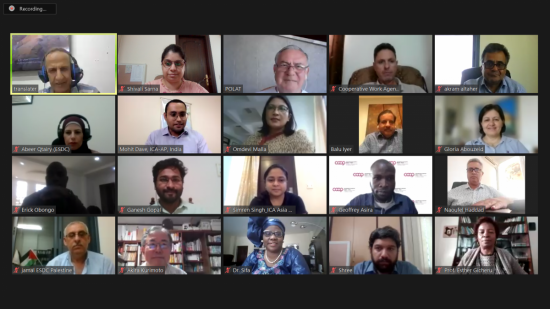
The ICA Asia and Pacific (ICA-AP) along with the Economic & Social Development Center (ESDC) of Palestine and the ICA Africa office organized an online consultation on the Statement of Cooperative Identity (SCI) for the Middle East and North Africa (MENA) region on 29th June 2021. The consultation was helpful to reflect on how the SCI guides day-to-day operations (practical challenges and strategies to overcome them); sets cooperatives (membership and value-based) apart from other business enterprises; fosters member interest and responsibilities; enhances the effective ‘cooperativeness’ of their organisations; and helps to build relationships with government and stakeholders.
Mr. Balasubramanian Iyer, Regional Director, ICA-AP welcomed all participants and apprised them of the SCI consultation series and the importance of awareness campaigns to shed light on the contribution of cooperatives. Ms. Om Devi Malla, Member, ICA Global Board and the Congress Advisory Committee; Prof. Esther Gicheru, Member, ICA Gender Equality Committee and Chair, ICA Africa Research Committee; and Prof. Akira Kurimoto, Member, ICA Principles Committee and Chair, ICA-AP Research Committee joined to advise and guide the discussions. They emphasised the need for a better enabling environment to regulate the sector, setting standards for governance models, the incorporation process, legal obligations, voting rights, board composition and functions, and contributions to local communities. Mr. Akram Al Taher, Executive Director, Economic & Social Development Center, Palestine moderated the consultation.
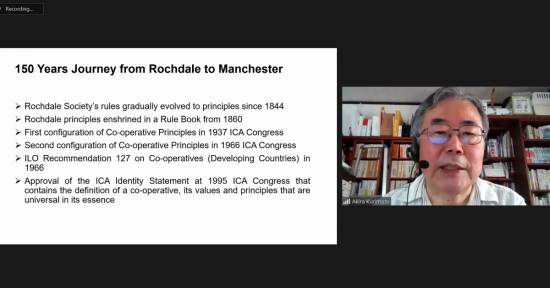
The participants said that cooperatives can deliver lucrative economic and social benefits to the Arab region. A full-fledged strategy should be formulated by governments to understand the market potential for cooperatives. This should take into account priority sectors where cooperatives play a significant role in providing essential goods and services for communities. Cooperative education programs in schools were also discussed as excellent forums to raise awareness among students and its importance for local communities and to instil the cooperative spirit.
Members of the Arab community should be encouraged to join cooperative movements. Mr. Hüseyin Polat, ex-Professor of Cooperative Management and Training at the ILO, discussed some of the initiatives undertaken by ICA towards strengthening engagement with cooperatives in the MENA region and in advocating the ILO recommendations 193. Dr. Sifa Chiyoge, Regional Director, ICA Africa thanked the delegates for their participation and touched upon ICA’s priorities in Africa.
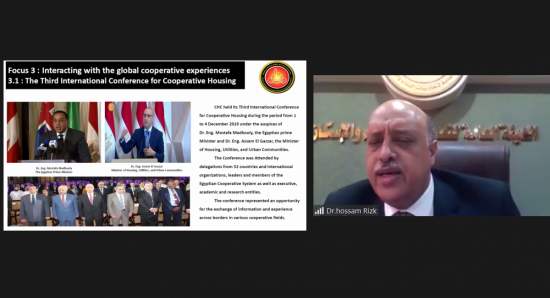
The consultation helped underscore the need for government departments and cooperative federations to work closely with the ICA to leverage synergies of global partnerships and economies of scale. The governments in the countries of the MENA region need to take cooperatives into account by carrying out consultations with the sector when developing economic policies and regulations and creating legal frameworks. The cooperative sector deserves equal treatment with other economic sectors, as they have a distinctive structure that is member-driven, well-integrated in communities and built from the ground up. Moving forward, the organizers will leverage the findings from the consultation to promote an environment for cross-border support with increased ICA membership in the MENA region and enhanced efforts towards international partnerships.


