
The Policy Forum on Development (PFD) together with the European Commission (EC) and European External Action Service (EEAS), as part of the consultations around the 2021-2027 programming of the European Union (EU), held a consultation on the EU Regional Multi-annual Indicative Programme (MIP) for Asia and Pacific, on 19th May 2021. The consultation was held to capture the views of the multiple PFD stakeholders, Civil Society Organisations (CSOs) and Local Authorities (LAs).
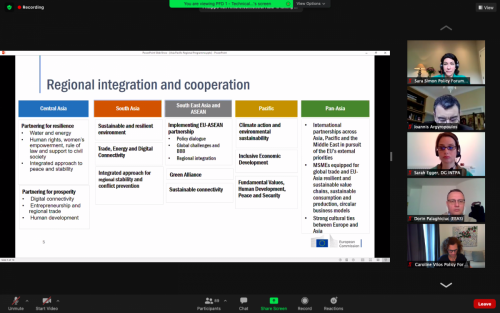
The EU representatives have identified three key priorities - regional integration and cooperation, pursuit of EU interests with key partners, and migration and human mobility. Each of the priorities reflected the concerned sub-regions (Middle East, Central Asia, South Asia, South-East Asia, and the Pacific) and countries with no dedicated national programmes, notably India, China, and other high-income countries. Financial resources catalysed by EU guarantees/ blending under the European Fund for Sustainable Development plus (EFSD+) are expected to be replenished and become operational over the coming months with the adoption of Neighbourhood, Development, and International Cooperation Instrument (NDICI).
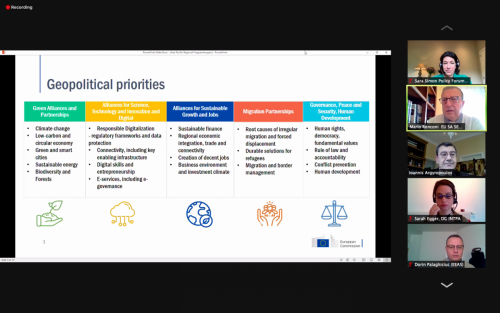
The moderated discussion comprised of an introductory presentation and Q&A session on the current thinking around the Asia and Pacific MIP. This was followed by an interactive plenary discussion on two questions – 1) How to best operationalise EU interaction to support the implementation of the programme in line with the foreseen regional priorities, and 2) What aspects of the programme are most relevant and important for our members? What is missing? And in which areas of the EU’s work we see maximum possibilities to enhance joint action with the EU to meet the SDGs?
Considering the important role that cooperatives play and the relevance of their views, ICA global and regional offices along with few member organisations participated in the virtual consultation. ICA-AP presented its views that the EU Delegations should consider cooperatives as partners across all programmes and advocate for dedicated CSO allocations in all geographic programmes. ICA-AP reiterated that the EU should invest in local businesses, cooperatives, smallholder producers and family farmers in rural areas to help rural communities become catalysts of an inclusive and equitable rural transformation that, in turn, can support sustainable urbanization. ICA-AP also suggested that the EU should simplify the design and delivery of EU external assistance by lifting administrative and financial barriers for CSOs that cannot carry high risks and costs related to programming. This will allow CSOs and cooperatives to be better represented at the EU partner country level.
On the thematic areas of interest, ICA-AP remarked that the EU should promote and strengthen the development of alternative digital platforms – platform cooperatives, that promote the democratisation of data, redistribution of wealth, and ensure decent jobs and social protection for workers in the platform economy. Additionally, the EU should acknowledge community ownership through cooperatives and the role of citizens as consumers, workers, and investors as a pathway to achieving the green transition.
The PowerPoint presentation and other relevant documents of the programme are available on Capacity4dev.


