
On October 9, the Federation of Peoples’ Sustainable Development Cooperative (FPSDC) brought together 34 delegates representing 20 co-operatives and civil society organizations from the Philippines for a learning visit to Japan. The visit was made possible through the assistance of ICA-AP as part of its mandate to boost cooperation by developing business relationships and partnerships among its members.
The FPSDC delegates made an official visit to two of the largest co-operative networks in Japan: The Japanese Consumer Co-operative Union (JCCU) and the National Federation of Agricultural Co-operative Association (ZEN-NOH). It is noteworthy that unlike in the Philippines, co-ops in Japan are regulated by different Acts, such as the Consumer Co-operative Act (1948), the Agricultural Co-operative Act (1947) and the Fishery Co-operative Act (1948), among others.
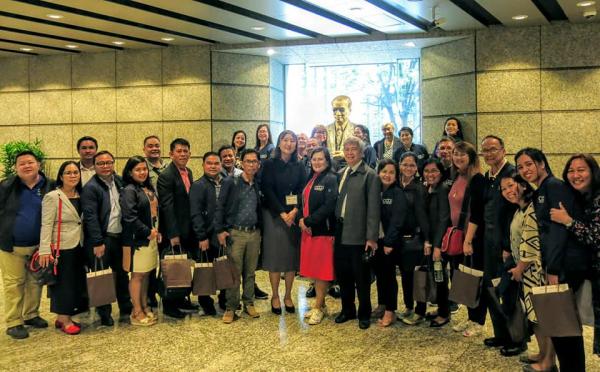
The FPSDC delegation meets with JCCU
At JCCU, the delegates were warmly welcomed by Mr. Jiro Ito, Director of Public Relations Division and Ms. Kanako Miyazawa, Senior International Officer, who introduced and discussed the profile, membership and business of JCCU. JCCU plays a vital role in value chain as developer and supplier of CO·OP Brand Products to its member co-ops, actively participates in communicating with other organizations and makes policy proposals concerning the consumers’ co-operative movement. A feat that FPSDC aims to emulate and achieve in the future. After the introduction, the group moved on to their exhibition of different consumer products showcasing JCCU’s CO.OP brand. Another thing that the participants learned from JCCU is the continuous improvement/innovation of delivery of products to their consumer-members, especially to large population of aging citizens.
At the the JA Building in Chiyodaku, Tokyo, Mr. Kenki Maeda introduced the Japan Agricultural Cooperatives group and its businesses. He described how agricultural co-operatives operate in Japan. ZEN-NOH is in charge of the marketing and supply business of the JA Group. It seeks to connect producers and consumers, revitalize production centers, and preserve society and the environment. This is where the federation and co-operatives in the Philippines relate to - where co-operatives play an important role in value-chain in the agricultural sector.
At the end of the learning visit, the realization that the Philippine co-ops are far behind their Japanese counterparts. However, all is not lost. As a country blessed with so much resources, the co-op movement can do its part in making the Philippines great. What needs to be done and a challenge at the same time is to instil discipline, temper greed and teach the Filipino people to be cooperative with their leaders. But most of all, put their faith and trust in God Almighty. The change for the better that Filipinos so desire will only be achieved if that change starts within themselves. And FPSDC hopes to be the spark that will ignite this change: First to its member co-ops, then eventually, the same change will infect other organizations and finally the Philippine society as a whole.


