
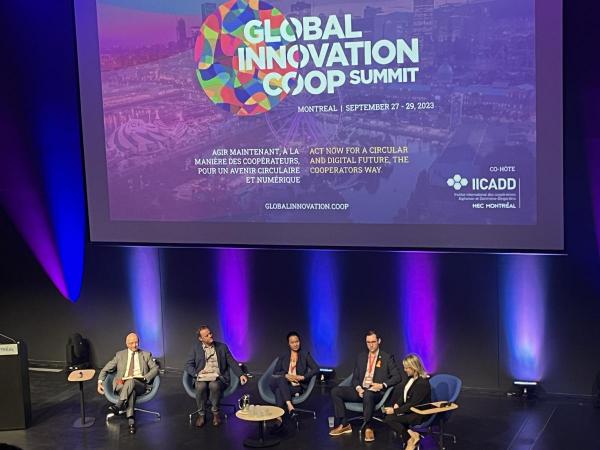
The three themes for the second edition of the Global Cooperative Innovation Summit (GICS) - “Act Now to lead a circular and digital future the cooperators' way”, collectively underscored the cooperative movement's ability to lead, embrace circularity, and thrive in the digital age. The Summit sessions highlighted the cooperative principles that guide these endeavors, emphasizing the importance of collaboration and innovation in the quest towards a more sustainable, equitable, and digitally adept future.
In a world where our natural resources are overexploited and the challenges of climate change continue to mount, it has become imperative to rethink approaches to production and consumption. The session on "Embracing Circular Economy" delved into the essence of circularity, its strategies, and innovative ways for participants to address the concerns of their communities. The objective was to explore pathways toward a circular and cooperative way of conducting business, emphasizing the significance of this transition.
Mario Pansera, Director at Vigo's Post-Growth Innovation Lab in Spain, shared crucial perspectives and emphasized that while most Circular Economy initiatives have concentrated on how to produce circularly, they often neglect equally vital questions related to what, how much, and for whom to produce. The success of transitioning to a sustainable Circular Economy isn't solely reliant on developing new technologies; it also hinges on the democratization and participation in the governance of productive processes. This transition must not only account for the planet's physical limits but also ensure justice, inclusivity, and democracy.
The session on Circular Business Models for Cooperatives explored strategies and business models for cooperatives within a circular economy context. The session on Community Energy discussed how cooperatives can develop community-owned initiatives and foster sustainable energy practices while the Circular Housing Cooperative focused on sustainable building practices, waste reduction, and increasing access to affordable housing. The aim was to find solutions through policy, finance, industry, and end-user perspectives. The COVID-19 pandemic underscored the interconnectedness of health, economics, and the environment. One Health - The Positive Circle: emphasized the importance of considering health issues within the context of the circular economy.
The "Living Digital" theme encapsulated the urgent need for cooperatives to embrace digitalization. Two experts, Laurent Charlin, Principal member at MILA, and Guy Cormier, President and CEO of Desjardins Group, Canada, shed light on how digitization and artificial intelligence (AI) are reshaping our lives and businesses. They emphasized that the pandemic isn't merely a temporary disruption but a catalyst for long-term change. Cooperatives must rise to the occasion by reinventing their operations, improving services, and enhancing community engagement in the digital age.
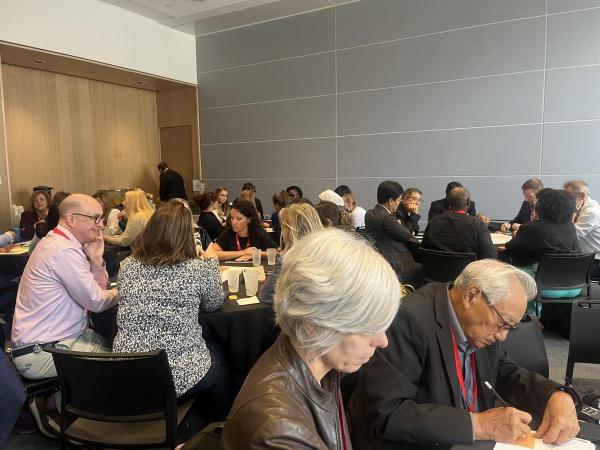
The breakout sessions showed that digital transformation is not a luxury but a necessity for cooperatives to thrive and remain relevant in an ever-evolving world. The session on Digital Coop Governance navigated the intricate relationship between established cooperative governance models and emerging ones rooted in digital technologies. Collaborative governance blockchain-based decentralized autonomous organizations (DAOs), and open-source collectives are revolutionizing how cooperatives organize themselves, often transcending traditional structures. The session on Digital Coop Sustainability tackled how digital technologies can bolster cooperatives' efforts in aligning with their sustainability goals while addressing challenges to data management, energy consumption, and behavior standardization. Despite cooperative networks being well-established, online collaboration among cooperatives remains a challenge. The session on Digital Intercooperation explored why replicating cooperative networks online is complex and how digital technologies can enhance collaboration among cooperatives.
Together we LEAD encapsulated the power of Principle #6 - Cooperation Among Cooperatives. While each cooperative may operate independently, their collective strength is a force to be reckoned with. It's a testament to the spirit of cooperation that lies at the heart of the cooperative movement. Paul Cabaj, from Taktika Sustainability Solutions in Canada, explored how cooperatives can overcome challenges and leverage collaboration to expand the cooperative movement on a global scale and across all sectors. Howard Brodsky, Co-founder & CEO, CCA Global Partners called to action to harness the collective strength of cooperatives to address pressing global issues.
Organizing Collectively to Transform examined real-world, purpose-driven examples and explored the practical implications of cooperation. The session on Cooperation Throughout the Supply Chain delved into successful strategies for building cooperative-to-cooperative businesses while the session on Multistakeholder Cooperative Governance addressed the unique ability of cooperatives to engage multiple types of members to tackle complex societal challenges and address a wide spectrum of issues, from social integration to circular design, ethical finance to environmental impact. Networking Among Co-ops and Non-Co-ops for Local Empowerment explored the diverse ecosystem required to support a thriving cooperative movement and looked into the roles and organizations that create regional hubs for cooperation.
Among the information sessions were the ones shaping the ICA Consultation on the Cooperative Identity; the UNRISD's Sustainable Development Performance Indicators (SDPIs); and the successful intercooperation story: the Consortium of Cooperative Resources and Expertise.
A key unveiling was the official launch of the International Coop Communities of Practice (ICCP) to exchange ideas, share one's successes, and possibly establish cooperative partnerships. ICCP aims to collectively develop international initiatives dedicated to creating a sustainable future for all. The ICCP strives to capitalize on opportunities to fortify our stance in alignment with the SDGs, amplify our positive influence on our members, and enhance our impact within communities.
More information at: https://www.globalinnovation.coop


