
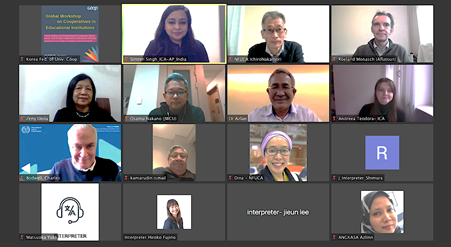
A global workshop was organised by ICA-AP Committee on Cooperatives in Educational Institutions (ICEI) on 28 November 2021. The workshop, held online, on the theme ‘Building and Strengthening Cooperative Identity among Youth through Cooperatives in Educational Institutions’ was attended by around 70 participants. It was organised in collaboration with the Korea Federation of University Cooperatives (KFUC) and Office of International Programmes at Shri Ram College of Commerce, University of Delhi.
‘Catch them Young’, is a popular premise on which strengthening of any movement rests. The cooperative movement, too, needs the infusion of young blood. Educational institutions, in general, and higher education institutions, in particular, make young people aware of principle-based - enterprises like cooperatives, through effective integration of cooperative elements in the curriculum. However, the cooperative learnings acquired in the classroom will be much more appreciated and the cooperative values ingrained if they are complemented with hands-on experiences in cooperatives. In this sense, educational institutions, together with cooperatives functioning within their campuses, can be effective catalysts in building the cooperative culture and strengthening the cooperative identity. While the curriculum and co-curriculum give youth an overview of the functioning of cooperatives; cooperatives in their schools and universities promote self-help, create a participative environment for the entire campus community, support education and most importantly, make young people realise the value of and need for the cooperative- principle and value-based ways of doing business. Keeping in mind the enormous significance of cooperatives in educational institutions, ICEI organised a one-day global workshop to bring onboard perspectives from different cooperative experts on global best practices; and key recommendations to build and strengthen the Cooperative Identity among youth through cooperatives in educational institutions.
Mr. Kim Jong-Weon, KFUC President opened the workshop with his welcome address. The opening address was delivered by Dr. Mohd Azlan Yahya, ICEI Chairperson, who thanked KFUC and the Office of International Programmes at Shri Ram College of Commerce for collaborating with ICEI for the workshop. Mr. Balasubramanian Iyer, ICA-AP Regional Director, delivered the keynote address.
The first session on ‘Building Cooperative Identity from the Grassroots: Global Practices’ featured presentations from Asia and Pacific, Africa and Europe. From Asia and Pacific, Dr. Yashwantha Dongre, ICEI Co-Secretary and Visiting Professor at Ritsumeikan University, Japan presented an overview of cooperatives in educational institutions in Asia and Pacific. Ms. Gemma Obeng, Head of Projects at the Cooperative College UK discussed Cooperative Identity for the millennials and the curriculum developed at the College to engage youth in cooperatives. Ms. Hilda Ojjal, President of ICA Africa Youth Network shared an overview of the school cooperative model in Lesotho and Kenya. Ms. Oh Meehye from Sungsil University Cooperative, South Korea walked us through campus cooperatives in South Korea via an exciting e-tour. The e-tour was greatly appreciated by the participants and was a major highlight at the workshop.
In the second session, a panel comprising of representatives from the ICA, ILO, Aflatoun International Angkasa, and Japan Worker’s Cooperative Union (JWCU) discussed how to promote cooperation among children and youth for the future of work and explored opportunities for partnerships with each other. The panel discussion was moderated by Ms. Zenaida Diola, ICEI Co-Secretary.
Ms. Andreea Teodara from ICA Global Office in her address presented an overview of initiatives undertaken by the ICA to engage with young people. She highlighted the importance of working closely and supporting youth in the cooperative movement.
Dato Kamarudin Ismail from ANGKASA and ICA Global Board Member shared that school cooperatives in Malaysia were started in 1968 and they currently operate in 2,400 secondary schools with 1.16 million individual members who are students aged between 12 and 18 years. They operate and run the business activities of school cooperatives. Almost all secondary schools in Malaysia have a school cooperative as it is a mandate of the Government to give students an opportunity to get first-hand experience of cooperation.
Mr. Osamu Nakano from JWCU shared that worker cooperatives are integrated with the values of decent work in the world of work that young people enter after completing their studies. But it is not easy to join and work in worker cooperatives as in a normal for-profit company, workers are not involved in investment or management. They only work under the direction and supervision of their managers. On the other hand, in a worker cooperative, each member makes a capital contribution and is involved in its work and management. He noted that in Japan, students are given ready-made problem statements and taught skills to solve these problems. But they are not given a chance to experience new problems, think for themselves and make decisions on their own. He highlighted the importance of independent thinking and decision-making that lacks in mainstream education. He noted that there are not enough lecture programs with a focus on cooperative principles and values.
Mr. Charles Bodwell, Enterprise Development Specialist from ILO, spoke about project design manuals developed by the ILO for those who wish to set up cooperatives. These manuals, such as MyCoop for rural and agricultural cooperatives, guides people to establish partnerships they need. There are tools for eliminating child labour that can be used by cooperative members. He discussed ILO’s work with Small and Medium Enterprises in Bangkok in the context of limited funding, capacity and resources and the use of tools such as the Start.Coop, which has helped educate and handholding the local communities about cooperatives.
Mr. Roeland Monasch, CEO of Aflatoun International noted that Aflatoun International is a strong believer in the power of the cooperative movement to ignite young people to be agents of change. As the world is becoming increasingly more complex and inter-connected with many challenges and opportunities, cooperatives play an important role in guiding youth towards a better and sustainable future. Aflatoun helps young people get socially and economically empowered to become agents of change for their development and to be able to contribute towards the development of their communities. This is done by social and financial education imparted through a five-step approach: 1) mutual understanding and reflection, 2) develop positive self-esteem, 3) community awareness, 4) education on money and finance, and 5) learning by doing.
During the panel discussion, the following recommendations were provided by the distinguished panelists to promote cooperation among children and youth for the future of work:
- Involve youth in discussions and decision making
- Educate youth on the cooperative principles and values
- Educate youth on the solidarity economy and values of cooperation
- Explore potential collaboration between ICA, ICA regional offices and cooperatives; and Aflatoun International to promote social and financial education among children
- Share best practices and experiences of laboratory and youth cooperatives outside of the Philippines among other ICA member countries
- Encourage and support students who are part of school cooperatives to form and/or become part of university cooperatives to continue their learning and experience in the cooperative movement.
This was followed by a Q&A session with the participants.
The workshop was closed by Mr. Ichiro Nakamori, ICEI Vice-Chairperson with the vote of thanks and closing remarks. He thanked the distinguished speakers, panelists, and participants for attending the workshop and sharing their rich inputs.


