
Time will not solve the gender leadership gap; action will
Women have made significant progress in graduation rates in the field of business administration and law; natural sciences, mathematics and statistics, health and welfare (though the numbers need to improve in engineering, manufacturing and construction) and the gender gap in participation between men and women in the workforce is narrowing, even though participation in the workforce for women is 49.6% compared to men at 76.1%. But, when it comes to leadership, the numbers are stark. According to the 2016 Grant Thornton Report, women held under a quarter (24%) of senior roles across the world in 2016—an increase of only 3% from 2011; one-third (33%) of global businesses had no women in senior management roles, a number which has not changed since 2011. Across the spectrum of literature, there is overwhelming evidence of a large presence of women getting ‘stuck’ at the middle management level, with no means or support to move higher up.
The 2015 ICA Study, Advancing gender equality: The Co-operative Way showed that within the co- operative movement, there has been a growing attention to gender issues, a progression of women into leadership roles, albeit slow, and an increase in the number of women-owned co-operatives. However, even in co-operatives, the asymmetry in leadership position between men and women exists. Women comprise over 50% of membership and over 50% of the clientele. Almost 75% of survey respondents stated that among the co-operatives with which they are most familiar, women comprise less than 50% of the co-operative board. A quarter of those same respondents reported that women occupy less than 10% of the board. As these figures suggest, women are among the most involved in and served by co-operative organizations, but among the least likely to hold high-ranking and decision- making roles.
Since co-operatives are exposed to serious competition from the open market and specialized private businesses, it is time to be professional in approach and delivery. Keeping in view the market demand, many co-operatives are hiring qualified CEOs to run the businesses. Moreover, there are a number of women working in senior and middle managerial levels in many co-operatives and a pool of qualified talent is already available. Women CEOs in co-operatives have already proved their mantle.
The quest towards achieving gender equality in decision making in co-operatives begins by looking within. This is ICA-AP’s first attempt to look for ‘Women CEOs’ in the region and find out about their journey to the ‘top job’, to contemplate on why they are almost invisible, what are the challenges and opportunities, and what can be done to tackle the issues.
The Workshop was jointly held by the ICA-AP Committee on Women, ICA-EU Partnership on Co-operatives in Development and the All China Federation of Supply and Marketing Co-operatives (ACFSMC) from April 17 to 19, 2018 in Renaissance Guiyang Hotel, Guiyang, Guizhou Province, China.
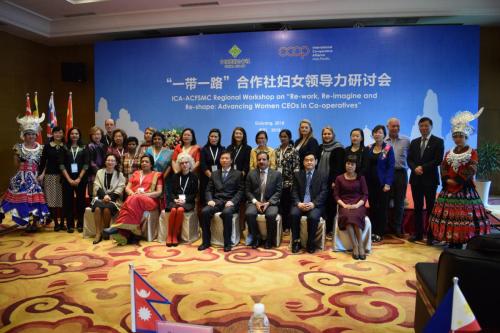
Participants of the workshop at the Opening Ceremony
Over the two days of the Workshop, there were three panel discussions on the themes - The case of the missing women Chief Executives: Breaking down the current scenario of the gender gap in executive leadership of Co-operatives; Gender equality at top management of cooperatives: Women CEOs-seen and heard; and Data leads the way: Strengthening data collection and analysis on the status of female executive leadership in Co-operatives.
The panel discussions were enriching and in useful in providing perspective not only from the point of the CEOs, but also from other participants who spoke about their understanding of the issue, how it affects the female employees in their organizations, and what they have done till to tackle it. Panel One helped establish the context and the current scenario of the gender gap at the executive level of co-operatives. Panel Two gave the female CEOs an opportunity to not only talk about their stints as CEOs, but also their personal journey till the point of being appointed CEO. Panel Three was a continuation of efforts at mainstreaming collection of gender-disaggregated data, which would assist in formulating policies to bring more women to the top from the mid and low-levels of management in co-operatives.
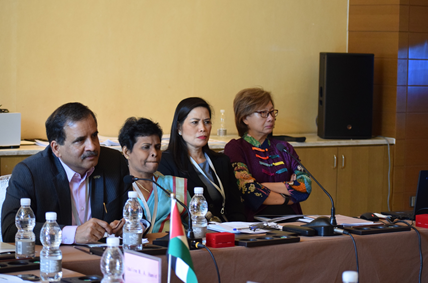
(L-R) Mr. Balu Iyer, Ms. Karuna de Silva, Ms. Elenita Sanroque & Ms. Dolly Goh during Panel 2.
Day 2 saw group discussion to formulate action points for members and ICA-AP, to further women CEOs in co-operatives. The participants were divided into two groups and after brainstorming, gave the following recommendations. Formulate gender equality policies (including HR policies) in co-operatives to create a diverse and balanced work environment, and to support and actively promote advancement of women across the co-operative ladder. Ongoing and regular collection of data to take stock of the status of executive leadership of women among ICA member; disseminate successful case studies of co-operatives led by women; and create an online portal which will have multiple purposes including uploading HR policies, capacity-building modules on leadership, and space for co-operators to speak with women CEOs for guidance.


