
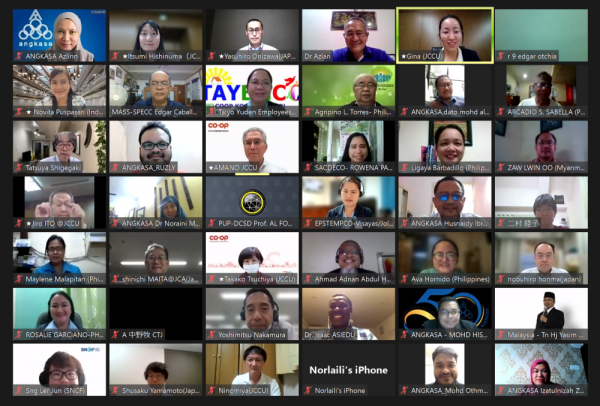
The ICA Committee on Consumer Cooperation for Asia and the Pacific (ICA-AP Consumer Committee) organized the Webinar on “Sustainability” in collaboration with the Japanese Consumers’ Co-operative Union (JCCU) on 16 September 2021. It was participated by 120 cooperators from 17 countries in the Asia-Pacific region.
This is the third webinar organized by the Committee in 2021, following the webinars on “Contribution to local communities” in June and the New Generation Stores “C&S Co-op Supermart” in the Philippines in August.
The webinar aimed to deepen the understanding of the businesses and activities of consumer coops (or coops in the retail sectors) to improve sustainability, boost inter-cooperative cooperation around the world, and discuss cooperative identity in the run-up to the 33rd World Cooperative Congress in Seoul.
Mr. Haruyoshi AMANO, Chair, ICA-AP Consumer Committee & Manager, International Department, JCCU, delivered the opening remarks, followed by a video message from Mr. Balasubramanian Iyer, Regional Director, ICA-AP.
The panel of speakers presented reports of their coops and sustainability activities. Mr. Yasuhiro Onizawa, Manager, Environment Promotion Department, Consumer Cooperative Kobe (Coop Kobe), Japan shared about CO-OP Kobe and its environmental activities such as its Environmental Challenge Goals, Food Recycling in its Eco Farm, Solar Sharing Initiative by generating solar energy and its new store using the 100% renewable energy.
Dr. Mohd. Azlan Yahya, Vice-President, ANGKASA, Malaysia & Vice-Chairperson, ICA-AP Consumer Committee explained the cooperative movement and consumer cooperatives in Malaysia. He shared ANGKASA’s three sustainable intervention programs – BA100 Program, 100 Champion Product Development and its Cooperatives’ Products Resource Centre (CPRC).
Ms. Novita Puspasari, a scholar-activist of Cooperative and SMEs & Researcher at Kopkun Institute, Indonesia explained about the consumer coops in Indonesia, how Kopkun Coop is managing its stores under the Covid-19 crisis and the kind of support Kopkun Institute provides to Kopkun Coop and its members such as education programs and innovations.
The presentations were followed by a brief Q&A session and all participants engaged in discussions around sustainability.


