
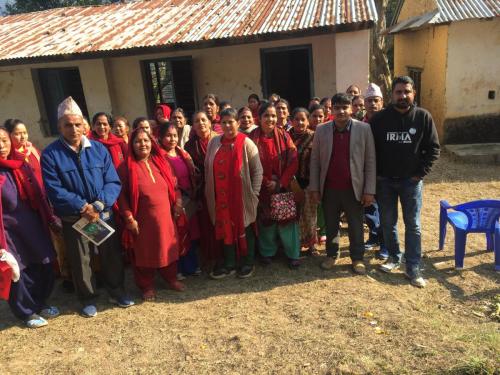
Yogeshkumar Joshi in Nepal during his internship with NACCFL
Yogeshkumar Joshi from the Executive Post Graduate Diploma in Management (Rural) from Institute of Rural Management, Anand, joined the Nepal Agriculture Cooperative Central Federation Ltd. (NACCFL), Kathmandu for a 2.5 month long internship. The internship was facilitated by ICA-AP. Yogeshkumar shares his internship experience and learnings with us:
My internship with NACCFL has been a great learning experience. I've learned the value of both transactional experiences and relational experiences. Working with small cooperatives operating in extremely challenging environments has been a very insightful experience. My experience with NACCFL, in Nepal and with the Nepali people has been heart-warming, despite the very cold winter!
NACCFL, established in 2008, is promoted by small farmers’ cooperatives with the purpose of providing non-financial services to small farmers' agricultural institutions and similar maturing agricultural institutions. The main objectives of NACCFL include policy advocacy, capacity building, network expansion, increasing agricultural production and productivity, value chain and market promotion. Currently, NACCFL has its network in 72 districts with 1066 small farmers’ agriculture cooperatives, with an outreach to 1 million households.
As an intern, I worked to design and develop a business plan for the dairy processing plant for Shree Tulsi Bhanjyang Small Farmers’ Agriculture Cooperative Ltd. (TSFACL), a district level agricultural federation having three tier structure and guided by cooperative principles. TSFACL is promoted, managed and operated by small farmers. They are headquartered in Galyang city and have 400 primary cooperatives associated with them, covering Malunga, Jagatradevi, Pakwadi, Tindobate, Tulsibhanjyang, Nibuwakharka, Pindikhola Batuwa and Pelakot Talukas of Syangja District, Gandaki Padesh, Central Nepal. TSFACL was established with the objective to incubate and provide operational support, training, development and extension services to primary cooperatives. It initially operated as a savings and credit cooperative, and has now evolved to agriculture, horticulture, floriculture and the dairy value chain. TSFACL operates in the mountainous region of central Nepal, dealing with major infrastructure gaps in road and electricity. Villages and households are scattered, and farmers have limited landholdings. While these factors restrict dairy cattle ownership in the region, agriculture and animal husbandry form the primary source of income for households here.
TSFACL is currently procuring an average of 2000 litres of milk per day. The milk is procured twice a day and stored in refrigerators in villages before being transported to the milk collection centre in Galyang. From there, it is sent to the Dairy Development Corporation. I worked on preparing a business plan for the processing unit, addressing inbound logistics, processing, production, outbound logistics, sales, marketing, cost and pricing, human resource planning and financial projections. These were challenging exercises! Especially considering the environmental and infrastructure constraints. To work around these constraints and develop economies of scale, my suggestions included increasing the farmer network, adopting technological solutions such as artificial insemination and veterinary services, route changes, and training to members.
The biggest challenge however, was a behavioural challenge, wherein locals were reluctant to shift their consumption patterns from loosely available milk to pasteurised milk. We are currently working on these challenges and hope to come up with a feasible solution soon.


