
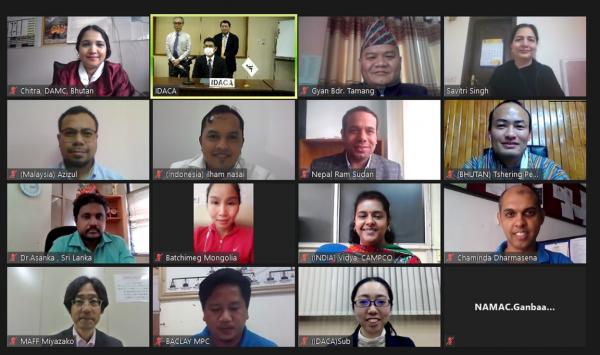
The ICA and the Ministry of Agriculture, Forestry and Fisheries (MAFF) of the Government of Japan, Tokyo signed an agreement for the implementation of the “Capacity Building Project for Farmers’ Organizations to Support the Development of Food Value Chain in Asia and Africa in FY-2020” for the period from 1st April 2020 to 31st March 2021, which comprises four programmes:
- Programme-1: Training Course on Strengthening Management and Development of Agricultural Cooperatives and Farmers’ Organizations in Asia and Africa.
- Programme-2: Training Course on Empowering of Rural Women for Improvement of their Leadership and Business and Management.
- Programme-3: Training Course on Strengthening of Marketing through Improvement of Quality of Farm Produce and Expansion of Marketing Channels.
- Programme-4: Follow-up Guidance and Survey of Ex-participants.
Given the ongoing impact of the COVID-19 pandemic and continuing restrictions on travel, the training programmes are being held online.
The first training course to be held online from 5th to 25th November 2020, was "Strengthening of Marketing through Improvement of Quality of Farm Produce and Expansion of Marketing Channels". The 21-day training was organised by ICA-AP in collaboration with JA-Zenchu (Central Union of Agriculture Cooperatives of Japan) and the Institute for the Development of Agricultural Cooperation in Asia (IDACA), Japan. It was attended by 13 participants including cooperative officials and leaders from eight countries – Bhutan, India, Indonesia, Malaysia, Mongolia, Nepal, Philippines, and Sri Lanka.
Agriculture, forestry, and fishery are a major source of livelihood in Asia and the Pacific region, major employment sectors and are therefore crucial for achieving economic development. The leaders’ statement issued in ASEAN +3 Summit in November 2017 includes promotion of agricultural cooperatives and improvement of their status and role in the markets and the food value chain (FVC). Furthermore, the Government of Japan proposed “Industrial Human Resource Development Cooperation Initiative 2.0” in the Japan ASEAN Summit in November 2018, anticipating human resource development activities for the next five years. With this objective, the training projects funded by MAFF are designed to foster/strengthen farmers’ organizations and agricultural cooperatives, promote agri-business by rural women and human resource to build FVC involving well-organized marketing of agricultural products.
Farmers’ organizations and agricultural cooperatives play a significant role in building FVC. Hence, the development of these institutions and human resources is expected to contribute to increasing farmers’ income, improving the investment environment, and expansion of business of food-related companies in the private sector.
The training was designed to cover topics such as:
- the agricultural and cooperative history of Japan
- the role and business of agricultural cooperatives in the socio-economic development of the farmers and rural community
- business models to improve the economic value of farm products thereby expanding markets and increasing farmers income.
The representatives of the organising partners delivered the opening address in the inauguration ceremony. Ms. Savitri Singh, Programme Director, ICA-AP and Programme Coordinator welcomed Mr. Miyazako Masahiro, Director and Senior Negotiator, Bilateral Affairs Division (Emerging Economies Group), MAFF; Mr. Hirofumi Kobayashi, Executive Director, IDACA; Staff of IDACA; and all the participants.
Ms. Singh gave an overview of ICA-AP and its various skill and capacity building services for members. She said that participants are selected with great care and it is expected that they will derive maximum benefit from the training and use the learning to strengthen the capacity of farmers and cooperatives in their respective countries. This was the first time the training was being conducted virtually; the course curriculum was designed to include more group work, video presentations, and facility to provide written answers to the questions.
Mr. Hirofumi Kobayashi, in his opening address, extended a warm welcome to everyone and gave an overview of IDACA and the objective of the training course. He mentioned, IDACA commenced its activities in 1963 based on the resolution at the 1st Asian Conference on Agricultural Cooperatives, hosted by Mr. Yasushi Hasumi, the first president in the history of JA Zenchu and the founder of this Institute. He said that this course is to let cooperatives in the region play important role to improve product quality, help member farmers get access to markets of high value-added products and facilitate their involvement in the food value chain effectively. He further said that post the training, participants will complete their action plan in responding to the core question – how to strengthen marketing capability of cooperatives, which will certainly play a significant role in ending rural poverty, strengthening farmers’ position in the value chain, and the sustainable development of agriculture in their country.
He observed that online communication has its limitations and hoped that the participants will be able to follow the training actively, as, for IDACA, online training is still a new form. Participants missed the opportunity to visit agricultural cooperatives in the countryside but to provide a good virtual experience, the organising team made their best efforts. He encouraged participants to openly ask questions and share any problem.
Mr. Miyazako Masahiro welcomed everyone and said that It is unfortunate to be not able to meet and attend the training in person; but online training will also provide a good learning opportunity. He said, under the current COVID-19 situation, many agricultural cooperatives and farmers organizations are facing difficulties in implementing their regular activities. Many of them, particularly in Asia, are successfully helping member farmers by distributing agricultural materials, collection and selling of agricultural products, etc. Their efforts are commendable because they encourage not only farmers but those suffering from the impact of COVID-19. He also shared that the expectations from agricultural cooperatives and farmer organizations are increasing under this pandemic situation and it will be great if this training course would enhance participant’s capacity to meet the expectations.
The Japan Agricultural Cooperatives or JA Group has comprehensive services and networks, from local cooperatives to the central organizations and strongly supports the Japanese agriculture systems. Mr. Masahiro hoped, the participants will get to know JA Group’ role in building the food value chain in Japan through their programme activities and post-training, they will be able to contribute to farmers’ communities. He conveyed his appreciation to ICA-AP, IDACA, and all the people who made every effort to implement this training course.
During the training, significant time was spent on preparation of individual action plans where ICA-AP and IDACA experts conducted one-to-one meeting with the participants. The participants are expected to submit their first report one month after the training and the second report after six months. A follow-up visit will be done by the ICA-AP-IDACA team to see the implementation of their action plans, the progress or lack thereof.
The course concluded on 25th November 2020 with a brief closing ceremony. The MAFF, ICA-AP, and IDACA representatives made closing remarks and a representative of the participants from Mr. Ramsudan from Nepal presented the vote of thanks. A ‘Certificate of Attendance’ was awarded to all the participants virtually; a physical certificate will also be sent to them.


