
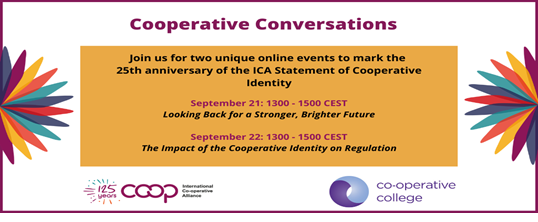
On September 21 and 22 2020, ICA in partnership with the Co-operative College UK held a discussion series, titled ‘Cooperative Conversations’ to celebrate the 25th anniversary of the ICA Statement on Cooperative Identity (ISCI). The Cooperative Conversations were held with the stalwarts of the global cooperative movement who have a rich background in academia, law, policy, and practice. Some of them have had a direct role in defining the statement on the cooperative identity, its cooperative and ethical values, and its seven cooperative principles. Young cooperative leaders from the Americas, Africa, and Europe were also invited to the discussion.
The story is 25 years old when the seeds of today’s conversations were successfully sown on the soil of Manchester during the 31st World Cooperative Congress, 1995. It was a special year as the ICA was celebrating its 100th birthday! During the centennial General Assembly of the ICA, the members “adopted for the first time a statement that manifested the international spirit and global movement of organising shared needs and aspirations through cooperative enterprise. This General Assembly was organised in conjunction with the Congress and established a common and harmonious identity of cooperatives, and included a definition, a set of cooperative and ethical values, and a modified set of seven principles” (ICA, 2020). A brand-new ICA Statement on Cooperative Identity was introduced to the world for the first time. The ISCI according to Professor Ian MacPherson (who for many years coordinated and prepared the adoption of the text), was “indivisible”. He noted that “the deletion of any element (in it) would make it collapse” (ICA, 2020). So, what is the ISCI about? The ISCI as we know today brought about significant changes to ICA’s formal statement on cooperative principles of 1966, such as the following (ICA, 2020):
- A definition of cooperatives was added to the statement for the first time.
- The cooperative and ethical values were added to the statement.
- Gender was added to the list of non-discrimination in the first principle.
- ‘Democratic member control’ replaced ‘one member, one vote’ in the second principle.
- The concept of indivisible reserves for the development of cooperatives was introduced in the third principle.
- ‘Autonomy and independence’ was added to the fourth principle which aimed to free cooperatives of interventions from governments and other sources.
- The fifth principle on education was rewritten and highlighted the importance of educating the young and opinion leaders about the nature and benefits of cooperation.
- ‘Concern for Community’ was added as the seventh principle.
The first Cooperative Conversation, titled 'Looking Back for a Stronger, Brighter Future' held on September 21, shed light on how the seven cooperative principles emerged and the significance of the global context at the time. It also involved reflection on the relevance and impact of the seven principles today and in the future. Interaction among the cooperative experts in this session, point towards a long and gradual evolution of the understanding and international consensus on the definition of cooperatives and their guiding rules aka principles.
One of the highlights was the introduction of the 7th cooperative principle, ‘Concern for Community’. It is symbolic that 20 years before the adoption of the Agenda 2030 (2015), values of sustainability and human-centred approach were officially integrated with cooperative identity. It is worth noting that this inference from the discussion strongly resonates with the current ICA-EU Partnership on Cooperatives in Development-People-Centred Businesses in Action ('#coops4dev') that positions cooperatives as development actors at the international level.
#Takeaway for Asia and Pacific cooperatives
As development actors, cooperatives in Asia and Pacific could join the Co-ops for 2030 Campaign launched under the ICA-EU partnership. This Campaign is for cooperatives to learn about the Sustainable Development Goals (SDGs), pledge their contribution to achieving SDGs, and report their progress. Currently, 33% of the total pledges made are from the Asia and Pacific region. 28 cooperatives from 14 ICA-AP member countries in the region have made 43 pledges across different SDGs. Further, cooperatives could also liaison with government organisations in their countries to communicate the critical role of cooperatives in SDG implementation and participate in local consultations on SDGs held with civil society actors.
The other noteworthy relevance of cooperative identity in today’s context is related to cooperative visibility. Italy based Gulliver cooperative has deployed an innovative reporting system to maximise the cooperative advantage and promote cooperative identity among its members and clientele. Along with its annual financial report, it releases a social report that is developed along the lines of cooperative principles and values. It informs readers about their social responsibility activities, ensures transparency and strong communication, and builds brand value.
#Takeaway for Asia and Pacific Cooperatives
To celebrate the cooperative identity and consciously differentiate the cooperative business from private or investor-owned business, cooperatives in Asia and Pacific could adopt the cooperative domain and marque. They were developed by the ICA as a global identity and logo for the cooperative movement. This will help cooperatives increase their brand value in a growing environment for fair, ethical, and eco-friendly production and consumption.
The second Cooperative Conversation, titled ‘Impact of Cooperative Identity on Regulation’ held on September 22 examined the impact of the ISCI on cooperative regulation at national and international level. The discussion shed light on the difference between law and regulation; amendments in national cooperative law in China, India, Japan, the Philippines, South Korea, and Vietnam following the introduction of the ISCI; and the emergence of international legal instruments like the ILO Recommendation 193 on the Promotion of Cooperatives and UN Resolution A/RES/72/143 on Cooperatives in Social Development.
One of the highlights from this session as noted by one of the revered speakers was that the ISCI is not simply a wish-list or philosophical document. It is a source of legislation and regulation for cooperatives and is fundamentally operational. It is also worth noting that one of the interpretations of the ISCI is that it is a legal text of an international non-governmental organisation and given ICA’s structure, the statement becomes legally binding on its members as well as their members. While the ISCI is an instrument for the ICA members, instruments developed by ILO and UN are for other general stakeholders (non-cooperative actors) who are bound to recognise cooperatives at the international and national level.
#Takeaway for Asia and Pacific Cooperatives
Cooperatives in Asia and Pacific could use the means of education and training to disseminate knowledge to members and associated stakeholders on the ISCI and its practical application in cooperatives for strengthening democracy and cooperation and ensuring gender equality among others. Further, cooperatives could liaison with national/ local education ministries to mainstream education and training on cooperatives in formal education to reach out to the young generation.
The striking point from this discussion was the importance of the definition of cooperatives, its principles and values within the changing world scenario and emerging Social and Solidarity Economy (SSE). It is noteworthy to mention that cooperatives enjoy exclusive recognition within SSE due to the laborious efforts made by the ICA members and supporters of the cooperative movement. Recently, the ICA came out with a position to support the United Nations Inter-Agency Task Force on Social and Solidarity Economy (UNTFSSE) initiative regarding a UN resolution on SSE.
#Takeaway for Asia and Pacific Cooperatives
Cooperatives in Asia and Pacific could familiarise themselves with the emerging SSE concept, its actors at national and regional levels and engage with them for a stronger SSE model in Asia and Pacific with cooperatives playing the central role in its development and growth.
Introduced towards the end of the 20th century, the ISCI holds relevance even today. The cooperative movement in Asia and Pacific could come together to have a similar chapter on cooperative conversations that takes into cognizance the diversity, strengths, issues and emerging trends in the region. Professor Akira Kurimoto, Chairperson, ICA-AP Research Committee represented the Asia and Pacific region at the August gathering of global cooperative experts invited to the Cooperative Conversations.
The full concept note on the ‘ICA Statement on the Cooperative Identity: Historical Context and Global Relevance for Today’ can be read here. The 33rd World Cooperative Congress will be held in Seoul, South Korea from 1st to 3rd December 2021. The theme for the Congress will be ‘Deepening our Cooperative Identity’ to strengthen the cooperative movement’s role in addressing global challenges and explore avenues to improve lives at the local and global levels.
Reference: ICA (2020). ICA statement on the cooperative identity: historical context and global relevance for today.
Article written by Simren Singh (views expressed are personal)


