
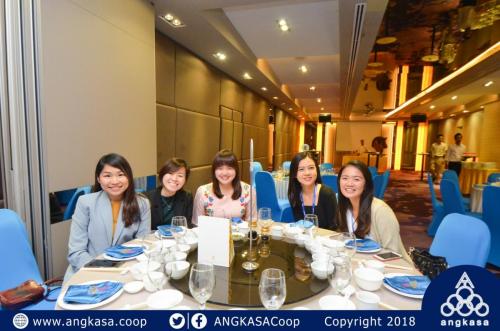
The ICA Committee on University / Campus Co-operatives in collaboration with the Malaysian National Co-operative Movement (ANGKASA) jointly organized the International School Co-operative Seminar from July 22-26, 2018 at Vouk Suites Hotel, Penang, Malaysia. The theme of the seminar was ‘Youth Empowerment Through Co-operatives for a Better World.’ The event was attended by 40 delegates from ICA member organizations, invited guests and resource speakers; and 70 high school students and teachers.
Dr. Mohd Azlan Yahya, Chair of the Committee and Vice President of ANGKASA in the ice-breaking session said that if youth are provided with skills and opportunities to reach their potential, they can become the driving force in achieving the 2030 Sustainable Development Goals (SDGs). ANGKASA’s approach is founded on supporting youth empowerment in co-operatives and partnering with all stakeholders who support progressive development of co-operatives in schools. The participants were then invited to introduce themselves and highlight their inspiration in joining this Seminar.
Datuk Mohamad Ali Hasan, Vice President of ANGKASA officiated the program at the Official Dinner in conjunction with the Seminar. In his speech he mentioned that the basic idea of forming school co-operatives is to educate students on co-operatives, instill in them entrepreneurial skills, and to empower them by introducing a democratic approach. A recorded message from Mr. Balasubramanian Iyer, Regional Director, ICA-AP was screened to the participants. Mr. Iyer highlighted the importance of campus co-operatives especially in bringing youth together and developing their skills as campuses are the best training ground for leaders of the future.
Three resource speakers representing key stakeholders from the Malaysian school co-operative movement shared their expertise and their role in empowering school students through co-operative entrepreneurial activities. Ms. Zuraidah Yahaya from the Malaysian Co-operative Societies Commission (MCSC) presented a paper on the History of Malaysian Co-operative Movement. She explained the role of MCSC in assisting schools in establish and form school co-operatives and providing grants to start-up business. Dato’ Kamarudin Ismail, Vice President of ANGKASA / ICA Board Member presented the Overview of School Co-operative in Malaysia and the role of ANGKASA as an apex co-operative in providing guidance and training as well as facilitating development of schools. The third paper on Favourable Policies in Promoting Co-operatives in Schools was presented by Mr. Wan Mohd Ariffin Wan Hussin, the Assistant Director of Ministry of Education, Malaysia. He touched on how the Government of Malaysia through the Ministry of Education makes it compulsory to establish co-operative in schools and encourages students’ involvement in co-operatives by providing merits to students, which is a plus point for their application to university level.
On the second and third day, the delegates got the opportunity to visit three different school co-operatives around Penang. The first was to St. Georges’ Girls’ School, a normal day-school with a very enthusiastic co-operative team and numerous entrepreneurial activities. The students explained about their structure, support received by the Principal and teachers and took the delegates to tour the school including their co-operative homestay in the school compound. The second visit was to the MRSM Kepala Batas, a junior college boarding school. Here the students benefit from co-operative businesses as banking agents, laundry service providers, as well as a child care centres for the teachers. The co-operative employs 17 staff to cater to the members; it includes cooks, co-op cafeteria staff, and drivers of the co-op transportation service. The third visit was to the Al-Mashoor Islamic Girls School, a school co-operative that is active in tourism activities. The students shared their experience in developing and offering affordable tour packages around Penang. Here, the delegates also got a taste of Malaysian traditional games and activities.
The delegates were inspired by the element of co-operative principles and values that are nurtured in the school students. A handful of delegates were very interested in collaborating, especially in adopting the Malaysian model of school co-operatives in their respective countries. It is ANGKASA’s aspiration to have school co-operatives established in other countries and is looking forward to assist co-operatives in the Asia Pacific region in the development of co-operatives in schools either using the Malaysian model or in establishing a better model that suits the local conditions.


