
The International Cooperative Alliance (ICA) celebrated IWD21 with a month-long social media campaign #coops4women, led by the ICA Gender Equality Committee (GEC) to showcase the importance of women in coop leadership for a just recovery.
ICA GEC released a short publication showcasing the regional best practices around the theme, “Women in leadership and COVID-19”. The publication featured the case of Working Women’s Forum (India) (WWF) – Indian Cooperative Network for Women (ICNW) and The Japanese Consumers’ Co-operative Union (JCCU) from the Asia and Pacific region. The publication can be accessed here.
On 8th March, ICA GEC shared a Declaration highlighting the important role played by women on the frontline in responding to the COVID19 pandemic. The GEC called upon the cooperators to work together and double the efforts to shape a strong, just, and equitable society in the post-COVID19 world. The declaration can be read here.
On 18th March 2021, the ICA Gender Equality Committee (GEC), in collaboration with the ICA-EU Partnership (#coops4dev), organised a webinar on ‘Women in Leadership for a Just Recovery’. The webinar was presided by Ms. Maria Eugenia Perez Zea (ICE GEC President). In her opening address, she noted that the webinar was one of the first activities of the ICA GEC in 2021 to show the various activities undertaken by women in cooperatives around the world. She added that having women in leadership positions is important for transitioning to a fair and just recovery post COVID-19. Women were the first in line to get affected by the COVID-19 pandemic as health care workers, caregivers, and community organisers. The pandemic has thrown a spotlight on women who at times have to face disproportionate burdens.
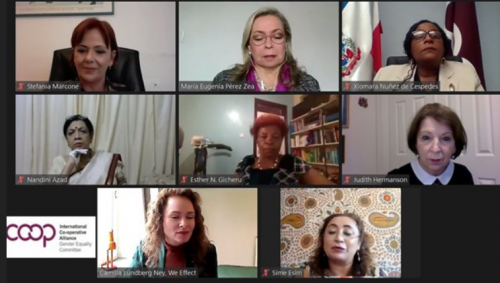
Through the webinar, women cooperative leaders from different parts of the world showcased various examples and best practices adopted by them to face the pandemic. The webinar was attended by over 180 participants from across the world. The first session, ‘Views and Updates by GEC Executive Committee members from the four ICA regions’, had Ms. Perez Zea; Ms. Esther N. Gicheru (GEC Executive Committee member and Chair of the Gender and Research Committee of ICA Africa); Ms. Xiomara Nunez de Cespedes (GEC Executive Committee member, Vice-Chair of the ICA GEC and Chair of the regional ICA GEC for the Americas); Dr. Nandini Azad (GEC Executive Committee member and Chair of the ICA Asia and Pacific Committee on Women); and Ms. Stefania Marcone (GEC Executive Committee member, Vice-President of Cooperatives Europe and Chair of Gender Equality Working Group at Cooperatives Europe) as the key speakers.
Ms. Perez Zea presented an overview of Coomeva, a cooperative group from Columbia, comprising of 17 cooperatives that provide a vast range of services including, wellbeing, financial health, housing, and entrepreneurship development. Coomeva has developed a gender equality and equity policy that applies uniformly to all 17 cooperatives. This policy is among the many initiatives undertaken by Coomeva for women, such as education and training, recognition of women entrepreneurs through awards, etc.
Ms. Gicheru presented the best examples of women cooperators in leadership from Africa from both mixed and all-women cooperatives, namely Awach SACCOS Ltd. (Ethiopia), Elgon Community Health Cooperative (Uganda), Moroccan Women’s Sewing Cooperative (Morocco), Ahikhomeni Va Vhassati Cooperative (Mozambique), and KUSSCO Cooperative (Kenya). The examples showed the initiatives and the contribution of women cooperators in fighting the pandemic. This included the production of masks by women cooperators from Morocco and the promotion of the Women Leadership Network by KUSSCO Cooperative in Kenya.
Ms. Cespedes presented the case of the Cooperative of Multiple Services of Nursing Professionals (COOPROENF, Dominican Republic) from the healthcare sector. It comprises of 18,000 medical professionals, 98% of whom are women. The women medical professionals were at the frontline battling the pandemic by not only caring for the patients but also ensuring that the members of the cooperative are supported and cared for. One of their initiatives was to develop a financial contingency plan that allowed members to take loans or advance salaries/payments during the lockdown and restricted cash flow.
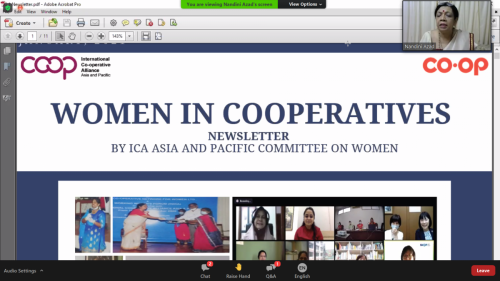
Dr. Azad shared an overview of the ICA Asia and Pacific Committee on Women and activities undertaken by the Committee during the pandemic. These included, 1) a virtual regional webinar to discuss the impact of COVID-19 on women in cooperatives in Asia and Pacific, and 2) the training of trainers’ program on Digital Financial Inclusion of Women Cooperators at the grassroots in India, organised in partnership with the Working Women’s Forum (WWF), Indian Co-operative Network for Women (ICNW) and with the support of Japanese Consumers’ Co-operative Union (JCCU). Nandini added that for a just recovery post COVID-19, there is a need to address the patriarchal mindset in cooperatives, promote women-based cooperatives, and promote women’s voice and participation in decision-making at all levels of cooperatives.
Ms. Marcone, who is also the former President of the ICA GEC, provided an overview of the work pursued by the Gender Equality Working Group at Cooperatives Europe, including the public advocacy on gender with the European Union representatives. She presented examples of women-led cooperatives in Europe such as the Rika Community Cooperative (Italy), FAI Cooperative (Italy), and school cooperatives (Spain) which have undertaken community service during the pandemic and are helping those in need, especially the elderly.
In the second session, ‘Perspectives on Empowering Women through the Implementation of Policies and Programs’, Ms. Simel Esim (Head Cooperatives Unit, International Labour Organisation), Ms. Camilla Lundberg Ney (Advocacy Coordinator, We Effect), Dr. Judith Hermanson (Director, International Cooperative Research Group), and Ms. Wenyan Yang (Chief of Global Dialogue for Development Branch in the Division for Inclusive Social Development of UNDESA) were the key speakers.
Ms. Esim shared four priority areas identified by the ILO where gender equality needs to be promoted for a just recovery after the pandemic. These included, 1) Measures for occupational safety and health for essential/frontline workers in the health sector 2) Protection of the informal economy workers 3) Protection of caregivers/workers 4) Measures to address gender-based violence. She said that there is an urgent need to implement policy and programs on gender equality and shared an example of the Violence and Harassment Convention passed by the ILO in 2019 which only four countries (Argentina, Fiji, Namibia, and Uruguay) have ratified to date.
Ms. Ney noted that the crisis accruing from the pandemic has to be addressed jointly for a just recovery. In her response to the question on challenges that women face in leadership, she noted that women in leadership can often be a lonely experience as women face both open and silent resistance.
Dr. Hermanson noted that cooperatives are leading the way to change the picture of women in leadership roles. She said that women leaders face complicated challenges and being on the decision-making table is not enough. It is also important that they are heard.
Ms. Yang opined that cooperatives are promoting women in leadership positions and allowing them to be part of decision-making processes. Sharing her views on the challenges faced by women leaders, she said that it varies from culture to culture and depends on their social-cultural identity. Therefore, gender equality must be addressed not just at an institutional level but also at the cultural level.
The webinar showcased many examples from all ICA regions on the work done by cooperatives and women cooperators before and during the pandemic. The speakers advocated for a stronger role and visibility of women leaders in the cooperative movement. They also emphasised the need for gender-disaggregated data in cooperatives for future policymaking.
Ms. Perez Zea concluded the webinar by thanking all the speakers for presenting their perspective and insightful examples of women’s contribution to the cooperative movement and towards a fair and just recovery post COVID-19. She congratulated all for their work during the difficult times caused by the pandemic.


