
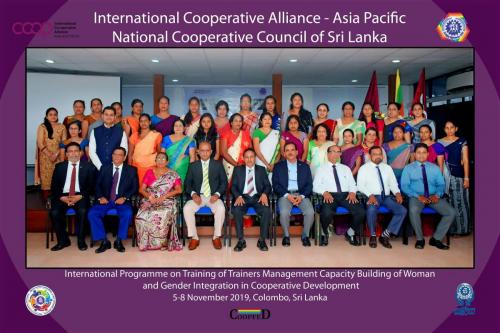
Participants with Mr. Suvinda S. Singapulli, Commissioner, Department of Cooperative Development
The ICA-AP Committee on Women in collaboration with the National Cooperative Council of Sri Lanka (NCCSL) and support from the Japanese Consumers’ Cooperative Union (JCCU) organized a Training of Trainers on “Management Capacity Building of Women and Gender Integration in Cooperative Development” at NCCSL in Colombo, Sri Lanka from November 4 to 8, 2019.
The objectives of the training were to take stock of the status and conditions of women in cooperatives in Sri Lanka and identify actions to promote gender equality. It looked at bottlenecks and challenges for women’s participation in cooperatives; co-relation between women, cooperatives and gender equality; gender integration in cooperatives, strategies for gender equality, and policy level measures; and global and ICA’s initiatives towards gender equality. The participants were also encouraged to share best practices adopted by cooperatives in Sri Lanka with a view to streamline the process of collection, analysis and dissemination of gender-disaggregated data.
Mr. Susil Shantha Weerasekara, Hon. Vice Chairman, NCC in his opening address noted the country’s developments in the quest for gender equality and women’s empowerment. Mr. Balasubramanian Iyer, Regional Director, ICA-AP introduced the participants to the program and delivered the special address on the need for gender integration in cooperatives. Mr. Suvinda S. Singapulli, Commissioner, Department of Cooperative Development in Sri Lanka in his inaugural address said that cooperatives have an important role in eliminating disparity and in driving social change. Mr. P. D. Liyanage, CEO, NCC, Sri Lanka delivered the vote of thanks to all dignitaries and participants.
25 individuals from ICA member organizations in Sri Lanka and cooperative department staff from different provinces participated in the workshop. They deliberated on strengthening policy; identifying and integrating gender-based gaps in cooperatives; mainstreaming gender in national policies (addressing safety and mobility); and targeting development programs. The training dwelled into how apex federations can use gender disaggregated data to plan, implement, monitor and evaluate in order to mainstream gender in cooperatives. The resources persons at the training were, Mr. Kumara Pothuwila, Project Manager of the We Effect funded project at NCCSL; Ms. Subhashi Dissanayake, Head of Business Planning, Development and Support at British Council in Sri Lanka; Ms. Ida Suhanya Jesu, Gender and Disability Officer, ILO Country Office in Colombo; and Ms. Taru Golla, Head of Partnerships with Access Livelihoods Consulting India.
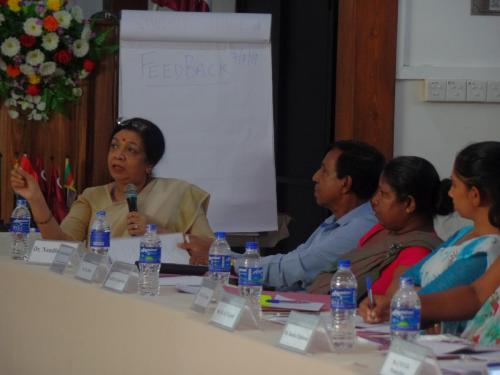
Dr. Nandini Azad, Chairperson, ICA-AP Committee on Women addresses the audience.
Dr. Nandini Azad, Chairperson, ICA-AP Committee on Women delivered the closing address and traced the history of the women committee and its role in gender mainstreaming and advocacy to increase representation of women in cooperatives. She said the Committee has consistently presented the concerns of gender imbalances and systemic discrimination against women at various levels of cooperatives and at important forums like the Asia-Pacific Cooperative Ministers’ Conference (APCMC). The Hanoi Resolution adopted at the 10th APCMC in 2017, called on all participants to “encourage and support women members’ participation (30 to 50% representation) in committees, bodies, councils and other higher-level cooperative structures.”
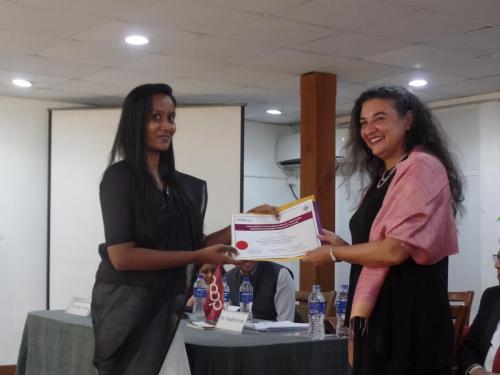
Ms. Simrin Singh (right), Director, ILO Sri Lanka & Maldives is presented with a memento.
Ms. Simrin Singh, Director, ILO Country Office for Sri Lanka and Maldives in her closing address welcomed the cabinet approval received for the country’s first - National Policy on Cooperatives. She said the ILO remains committed to accompany Sri Lanka in taking forward the National Policy and has also supported the translation of the policy document into Sinhala and Tamil. This endeavour would create greater discussion among cooperators, producers and consumers, and policymakers.


