
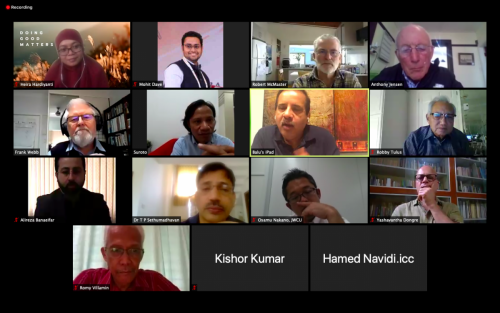
ICA Asia-Pacific (ICA-AP) in collaboration with Cooperative Development Network in Australia and with the support of the ICA-EU Partnership, organized an online roundtable discussion on worker cooperative buyouts on the theme, “Strengthening workers in the COVID-19 crisis” on 2nd September 2020. The countries represented at this stage of the discussion were Australia, India, Indonesia, Iran, Japan, Korea, and the Philippines. The roundtable successfully shared experiences in worker cooperative development addressing the issues of rising unemployment amidst the ongoing crisis and promotion of inclusive societies.
Mr. Balasubramanian Iyer, Regional Director (ICA-AP) opened the discussion talking about the effect of the economic fallout of the COVID-19 pandemic which is projected to be for a long time to come. During these times there will be an increase in companies under distress and rates of insolvency. Historically, worker cooperatives have formed during an economic downturn to save/ create jobs. This time around, it is going to be no different and we are expecting to see interest in worker cooperatives to assist:
- Distressed companies achieve a worker buyout
- Companies with a business succession problem to sell to its workers
- Freelance workers looking to form cooperatives to secure their work
- Social/ service workers who have been badly affected.
Many countries have put in place stimulus packages to kickstart the economy and revive businesses. Federations representing cooperatives in Canada and the United States are coming up with strategies to access government funds and use it to support worker cooperatives buyout.
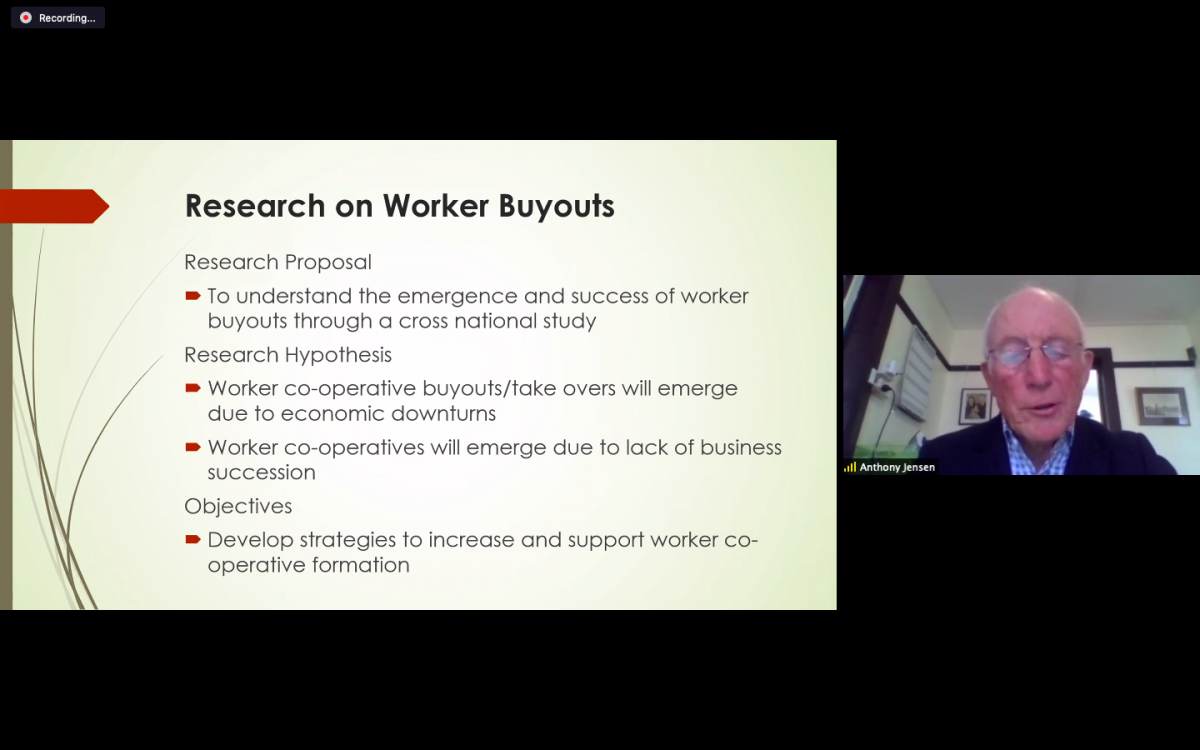
The recently published book, “Waking the Asian-Pacific Cooperative Potential,” has a chapter on workers cooperatives. There are case studies on six worker cooperatives of which three are worker buyouts and these demonstrated that the buyout process is difficult but doable. Professor Anthony Jensen, an expert in worker cooperative buyout, who edited the chapter on worker cooperative in the book is working on a worker buyout initiative in Australia and has written to their Treasury to support, based on the Marcora Law in Italy (1985). Building upon the experience, he presented a proposal for action-based research on the topic.
Dr. Yashavantha Dongre, Director, Planning Management Evaluation Board, University of Mysore shared about the case in India which has more than 50,000 worker cooperatives - the majority of them being a labour and/or artisan co-ops. The worker takeover examples have shown mixed results. A transport co-op formed by workers buying a private firm did well for well over 25 years but were recently in trouble. Kamani tube in Mumbai which was a failed private firm was taken over by workers and a co-op was formed, but it failed within 10 years. It has now been revived and profitably runs under private ownership. Some of the earliest examples of worker takeovers have been in the Northeastern part of India - the states of West Bengal and Tripura - both at that time under the communist rule - where tea estates were taken over by workers and successfully run. At present, there are only a couple of them working well. So, these experiences seem to have made the governments reluctant to support the formation of worker cooperatives. In any case, cooperatives being a subject handled by respective state governments, there is need to work for a clear policy at the state level. Kerala is an ideal state to begin such a process in India.
Dr. T.P. Sethumadhavan representing Uralungal Labour Contract Co-operative Society (ULCCS) agreed that they can convince the state government both to come out with a policy initiative and provide support for workers to take over the failing private firms and form co-ops. ULCCS would also be interested to buy such firms and/ or facilitate worker takeover of firms by workers of respective organisations and help them to stabilise.
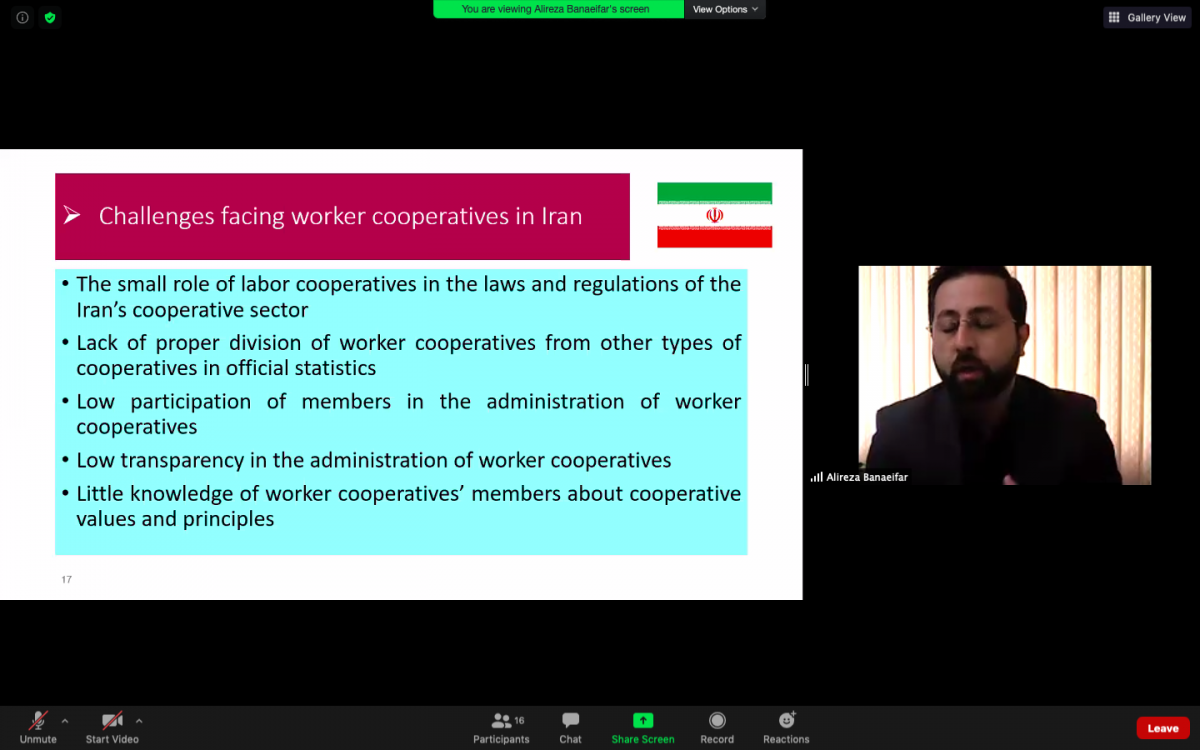
Recently the Japan Workers Cooperative Union submitted the “Workers Cooperative Act” for revision, which if passed, will enable worker cooperatives to be set up with their specific legal form. ICA members from the Philippines and Iran also made a presentation on the situation in their respective countries.
Mr. Rob McMaster, former Managing Director of C-Mac industries, the family firm that he sold to the employees as a worker co-op, brought the commercial perspective of an existing owner to understand the employee buyout process. He has written the book “Swapping Desks” as a memoir of his nine-year quest to preserve his family business, by converting it into one that is employee-owned. He shared his experiences to prepare business succession plans and encourage firms to consider employee ownership as a neat exit. The obstacles encountered show how Australia needed an official framework for employee ownership as a succession solution. He discussed that if C-Mac was a UK company, it could have been sold to an employee-ownership trust (EOT). Introduced in 2014, the EOT formalised a tried and tested succession solution and, also, provided a capital gains tax exemption for sellers and income tax-free bonuses for employees.
Mr. Frank Webb, General Manager of the Co-operative Development Network in Sydney talked about developing the business model and legal structure of the co-operative buyout.
The roundtable was useful to stimulate collaboration amongst stakeholders to promote a conceptual understanding of worker cooperative buyouts at multiple levels. The discussion gave an opportunity to know demonstrated interest, enabling environment, and the need for adequate funds and a pool of human resources to explore the worker buyout and other initiatives in the Asia-Pacific region.


