
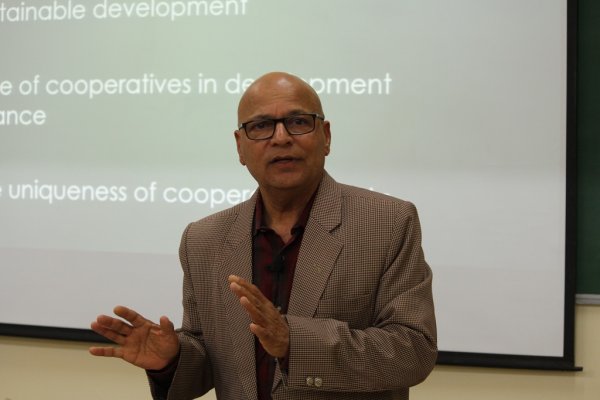
By Yashavantha Dongre, Visiting Professor, College of Policy Science, Ritsumeikan University, Japan & Co-Secretary, ICA-AP Committee on Cooperatives in Educational Institutions
Education, Training, and Information dissemination constitute one of the basic principles (Principle 5) as well as core values of the cooperative movement. Building cooperative identity by spreading awareness about cooperatives as well as imbuing professionalism among leaders, members, and staff of cooperatives, is an important and perpetual process. The International Cooperative Alliance (ICA) has stated that “cooperatives provide education and training for their members, elected representatives, managers, and employees so they can contribute effectively to the development of their co-operatives. They inform the public – particularly young people and opinion leaders - about the nature and benefits of cooperation”. The need for and modalities of facilitating education, training and information dissemination is elaborated in detail in the Guidance Notes to the Cooperative Principles. It is clearly emphasised that “a cooperative’s commitment to education is not simply inward-facing to members, elected members, managers and employees, but outward-facing too. It requires cooperatives to “inform the general public about the nature and benefits of cooperation”. This obligation to inform others about the nature and benefits of cooperatives applies “particularly” to “young people and opinion leaders.” The same sentiments are resonated in the United Nations Resolution A/RES/70/128 that identified the need for “integrating cooperative values, principles and business models into educational programming, including school curricula.”
Even though the need for cooperative education, to the youth, in particular, is seen as an important requirement for a long time now, the ground level situation does not seem to be very positive. It is rightly stated that “the inclusion of cooperative content within all stages of education from primary school through to adulthood is needed – or, at least at some stage(s)! At a minimum, cooperative curriculum should be integrated into existing secondary school courses”. But experiences suggest that in places where cooperative curriculum should be covered without question, such as in the college and university programmes, it is mostly absent. Given this scenario, there is a need to pursue concerted efforts to promote cooperative education and facilitate building cooperative identity among the next generation of leaders, professionals and entrepreneurs. While designing and introducing the curriculum related to cooperative movement at school and college levels is one way of doing it, starting cooperatives in the campuses is another equally important strategy. The curriculum helps to provide theoretical and technical knowledge about cooperatives and the presence of a cooperative on the campus serves as a laboratory, giving opportunity for hands-on learning. The Asia Pacific region has ample examples of the development of campus cooperatives in which the entire campus community - teachers, staff, and students - become members, participate, and serve their needs on a self-help basis. In India, campus cooperatives, especially school cooperatives were encouraged by the leaders of the freedom struggle, for they believed that these cooperatives can be effective instruments of collectivism and to nurture future leaders. School cooperatives in countries like Malaysia have demonstrated their ability to make the young students learn about the importance of cooperatives and mutuality. University cooperatives in Japan and Korea have developed into educational and student support service organizations providing all-around support to the academic community.
The ICA-AP’s initiative of starting a separate sectoral committee on campus cooperatives is indeed an important milestone underscoring the importance of such cooperatives as micro-level institutions imbuing the cooperative spirit among the youth. By renaming it as Committee on Cooperatives in Educational Institutions (ICEI), ICA-AP has provided it with the opportunity to address varied aspects of support services required for those pursuing education. While promoting the formation of campus cooperatives needs to be pursued aggressively, there is an equally important need of making cooperatives part of the curricula in general education. The ICEI‘s initiative to organise a webinar on cooperative education and curricula in the coming months is, therefore, a welcome step.
The curriculum must be designed to provide a general understanding of cooperatives at the school level and national and international cooperative movement at the higher education level. However, there are constraints in accommodating varied aspects of society and economy at the school level learning; therefore, it is not practical to introduce a separate course/ paper on cooperatives. High school level looks ideal starting point to introduce some modules and this can be done as part of a general subject such as Economics or Social Studies. For higher education (post-metric or university/college level), there are greater options. At this level, students normally opt for programs that make them job ready. This should be considered while designing the curriculum. Most universities/ higher education institutions offer Open Elective courses both at undergraduate and graduate levels. This is one of the best ways of making youth studying diverse courses, to study cooperatives. Apart from this, post-metric and post-graduate yearly diplomas fit better as the students get to study cooperatives within a shorter duration and stand a chance to be employed in the cooperative sector. At a professional level, such as graduate studies in Business, Economics etc., cooperatives can be an elective/ specialized stream. The modus-operandi of offering these courses are also equally important. Technology has inroaded into the education systems in a big way. Online courses, credit transfers, joint/pooled degree programmes, etc. are becoming the order of the day. This is a good opportunity for making the cooperative education curriculum available to the young population around the world. If such courses are offered online through reputed educational institutions, they can attract a lot more students. ICA-AP can play the role of a catalyst in this process. The HRD Committee, Research Committee, Youth Committee and ICEI will have to jointly plan and initiate a set of measures, through member organizations of ICA as well as through academic institutions, to facilitate designing and offering education curriculum on cooperatives in educational institutions.


