
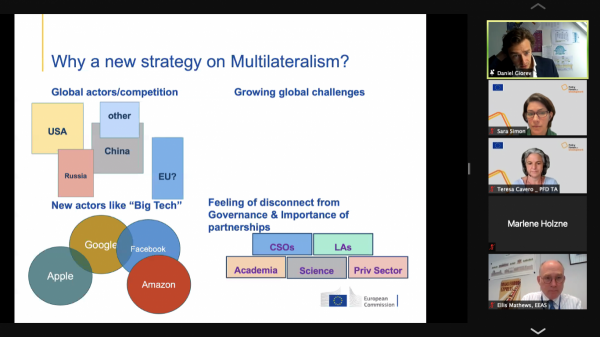
The European External Action Service (EEAS) and the Directorate-General for International Partnerships of the European Commission (DG INTPA) in collaboration with the Policy Forum on Development, organised a consultation on inclusive multilateralism on 13 September 2021.
In February 2021, a joint communication on strengthening the EU’s contribution to rules-based multilateralism was issued. The communication calls for a truly inclusive multilateralism, where “the voices of civil society, the private sector, social partners and others count.” The consultation on 13 September helped outlined its practical implications and responded to a strong interest by civil society and local authorities to be associated with the future work about the roll-out of the Communication. After a presentation by the European Commission and the EEAS, the floor was opened for discussions.
Mr. Mohit Dave, Program Manager, ICA-AP participated in the multilateral processes and shared the lessons learned. He noted that ICA-AP is working closely with various structures under SAARC and ASEAN to give broader recognition to cooperatives in their policies. A dedicated roadmap for the promotion of cooperatives is a key priority area for more inclusive multilateralism. Further from formulation and adoption, the said cooperative promotion policy’s implementation should be periodically reviewed and revised through a multi-stakeholder approach. Jordan in the past year (2020) has made positive steps in this direction.
He highlighted the need to tap into the synergetic capacity of the cooperative movement for more inclusive multilateralism and to create new knowledge around emerging products, services and markets—in particular, around new technology that can be adopted to address social and economic needs in a changing environment. ICA members who are international and national cooperative organisations from all sectors of the economy, namely agriculture, banking, consumer, fisheries, health, housing, insurance, and industry & services are one of the key stakeholders.
The ICA-AP in recent past has worked closely with various stakeholders such as the United Nations Department of Economic and Social Affairs (UNDESA), Ministry of Trade, Industry and Tourism of the Government of Fiji, SAARC Agriculture Centre (SAC), Asian Farmers’ Association for Sustainable Rural Development (AFA), Food and Agriculture Organization Regional Office for Asia and the Pacific (FAO-RAP), ICA Domus Trust (IDT), Andhra Pradesh Mahila Abhivruddhi Society (APMAS) etc. All these dialogues were successful in bringing together academics, development practitioners and other multilateral institutions from across the Asia-Pacific region to promote and advocate for people-centred, self-sustaining cooperative enterprises, guided by the principles of economic, social and environmentally sustainable development. Invoking the 6th cooperative principle of Cooperation among Cooperatives, ICA-AP encourages members to forge a joint front by engaging in multilateral settings to serve their members more effectively and strengthen the cooperative movement.


