
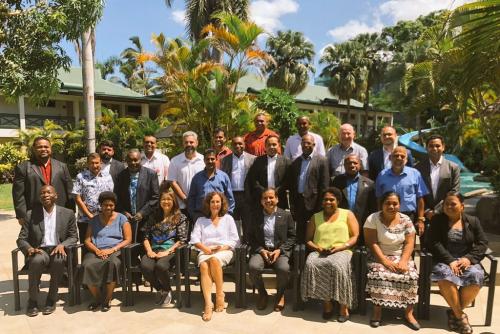
Delegates at the international workshop on the Role of Cooperatives in Sustainable Development in Asia-Pacific Countries, Nadi, Fiji
The United Nations Department of Economic and Social Affairs (UNDESA) organised an international workshop on the Role of Cooperatives in Sustainable Development in Asia-Pacific Countries, March 3-5, 2020, at Tokatoka Resort, Nadi, Fiji. The workshop was organised in collaboration with the Ministry of Trade, Industry and Tourism of the Government of Fiji.
Around 25 participants from national governments, civil society organisations and international agencies from Australia, Brazil, Fiji, Indonesia, Kiribati, Papua New Guinea, Solomon Islands, the Philippines and Tonga participated in the 3day workshop. Their active presence helped in strengthening the capacities of cooperatives in the region to support national and local efforts for achieving the sustainable development goals, and to build cross-country alliances for collaboration. The workshop was also useful in mainstreaming representation from the region in ICA’s development process, in understanding the realities of doing cooperative business, and the challenges faced by cooperative institutions in the Pacific Islands.
Mr. Balasubramanian Iyer, Regional Director of ICA-AP delivered the keynote address, focusing on the cooperative identity with its values of self-help, self-responsibility, democracy, equality, equity and solidarity. Commitment to these values across business models is fundamental, and ever more pertinent in today’s world.
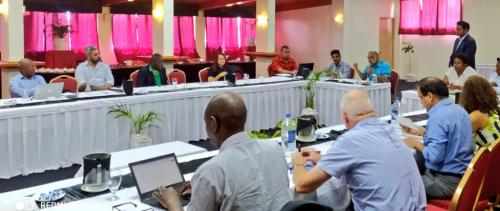
Delegates during a session at the workshop
The ICA-EU Partnership on Cooperatives in Development (#coops4dev) was represented by Ms. Ann Apps, legal expert for Oceania and Pacific island countries and Mr. Mohit Dave, Programme Manager, ICA-AP. Ms. Apps discussed the findings from her preparation and review of national reports from Vanuatu, Kiribati and Fiji, on their existing co-operative law as part of the Legal Framework Analysis research. She focused on better understanding the role of regulation and regulators in promoting cooperative development by securing a cooperative identity that is distinct from the ‘for profit’ company model. Mr. Dave presented the best practices for managing cooperative enterprises in different sectors and countries in the Asia-Pacific region, while maintaining the principles of cooperative organisations, with reference to the World Cooperative Monitor 2019 report. He also moderated the panel discussion with registrars from Fiji, Kiribati and Solomon Islands to discuss challenges and opportunities for growing the cooperative sector in their countries, and issues around compliance and competence.
The workshop provided a good opportunity for the registrars to examine synergies for expanding the scope of cooperative enterprises. It highlighted that the lack of education, ineffective legal and policy environments, lack of cooperative statistics, and access to finance were the main and common challenges for cooperatives in the Pacific.
ICA-AP will continue working in the region to increase membership and understanding through the ICA-AP Committees, the legal framework analyses and mapping exercises; and work to develop partnerships with the Pacific Islands Development Forum and arrange exchange visits. ICA-AP is currently working to support the creation of an enabling environment, strengthening cooperative federations, and establishing a regional network for cooperatives to promote the cooperative enterprise model in the Pacific.


