
By Nepal Agriculture Cooperative Central Federation Ltd. (NACCFL)
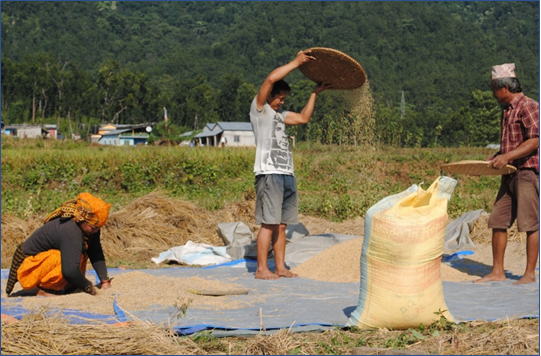
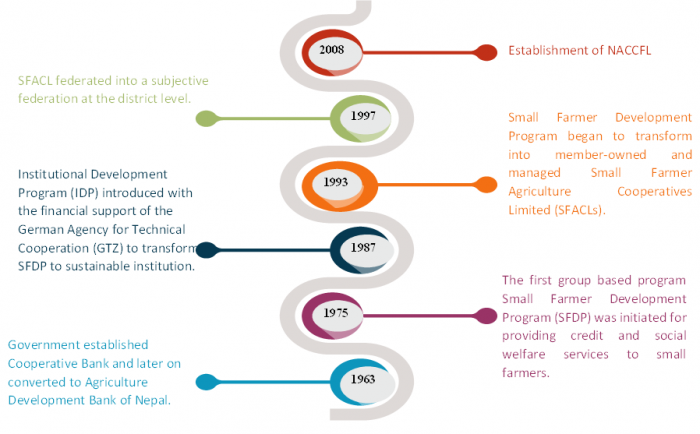
To alleviate poverty through the participation of rural marginalised members, the Small Farmers Development Program (SFDP) was jointly initiated by the Ministry of Agriculture, Nepal Government and Agriculture Development Bank in 1975 with the support of the Food and Agriculture Organization of the UN (FAO). With the support of the German Agency for Technical Cooperation (GTZ), the establishment of small farmers operated and managed the Small Farmer Agriculture Cooperative in increasing numbers along with sustaining, expanding and institutionalized activities under the framework of the SFDP program.
After more than a decade’s experience, these Small Farmer Agriculture Cooperatives Limited (SFACL)s were organized as district level federations and then gradually as a central level federation namely the Nepal Agriculture Cooperative Central Federation Ltd. (NACCFL) in 2008. Now, the NACCFL is a part of the small farmer agriculture cooperative system consisting of SFACLs. It provides both financial and non-financial services to the small farmers at the grassroots level, its federations (at district, province and national level) and non-financial services to the SFACLs, and advocates for the larger benefit of small farmers and its financial institution - Small Farmer Micro-Finance Institution that provides wholesale lending to SFACLs. NACCFL serves more than 1,092 member cooperative organizations in 75 of 77 districts in all provinces of Nepal.
Establishment of the Central Federation, NACCFL
NACCFL has been involved in policy advocacy, network expansion, capacity development, increasing production/ productivity and value chain development/ market linkages for the small farmers. The strength of NACCFL is its network and coverage. Its four-layered structure comprises of primary cooperatives (SFACLs) at the local level, district agriculture federations, provincial agriculture federations and NACCFL at the central level. Due to its rooted structure, it has developed good relationships with the municipalities, provincial government and central government.
For the development of small farmers, NACCFL implements the Statement on the Cooperative Identity (SCI) through activities like:
Advocacy and lobbying
NACCFL advocates and lobbies with the Government of Nepal and other relevant organizations on the issues of farmer members regarding the agriculture sector and cooperative development. It facilitates small loans for them for quality meat and milk products through Sana Kisan Bikash Laghubitta Bittiya Sanstha Ltd (Small Farmers Development Bank) which is backed by lobby activities, the Government of Nepal and other relevant stakeholders.
NACCFL is consistently lobbying with the Government of Nepal to establish a wholesale market for agricultural cooperatives within the Kathmandu Valley. NACCFL is the secretariat for the celebration and implementation of the UN Decade of Family Farming Program 2019-2028 in Nepal.
Capacity development for organization and individual members
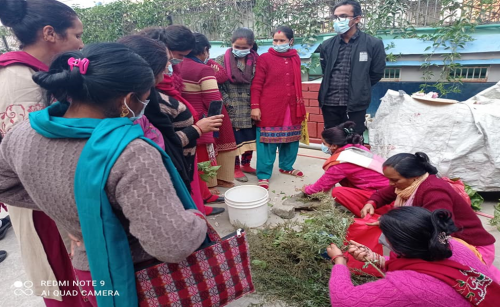
Participation of women members in a training regarding the making of organic pesticides
NACCFL has established a Training and Research Center in Chitwan, Nepal to impart training on different aspects viz agriculture, institutional development, finance, value chain, marketing, etc. The members of the cooperatives get benefited from this approach. It helps to increase production and productivity which enhances the livelihood of the members. More than 190,000 member farmers had been trained in different aspects through seminars and orientation programmes.
· Cooperative network expansion
Every year NACCFL replicate/ form around 50 primary cooperatives in different districts under the guidance of its replication manual. So far, there are 1,092 member organizations among which 45 are district agricultural cooperatives and 7 are provincial agricultural federations affiliated with NACCFL. Other similar agriculture cooperatives are also becoming members of the NACCFL.
Agricultural production and productivity
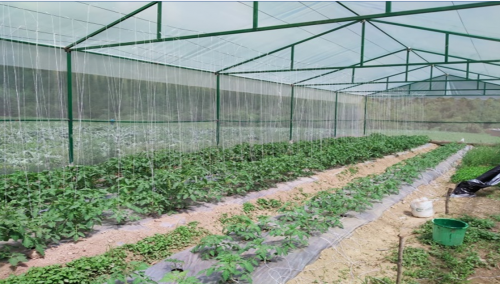
Tunnel farming by a cooperative member
The member cooperatives provide ago-input supply which supports the increase in production and productivity of the crops. After harvesting, production is linked with the market initiated by the NACCFL for thise who want to sell their agro produce. Small holders' farmers who aren't in a cooperative network also get an opportunity to get affiliation with the local level cooperative. And can get credit for allied sectors (horticultural, cereal, livestock and others) as well. This helps in increasing their livelihoods in long run. NACCFL in close collaboration with its partners provides agriculture trainings such as Enabling Rural Innovation Training (ERI), Insects and Pest Management, Soil Testing Campaign, Integrated Pest Management (IPM), Orgranic Farming, etc to increase the agriculture productivity of its member farmers.
Value chain development and marketing linkage of agricultural products
NACCFL has gathered a lot of experience in the seed value chain and livelihood aspects after implementing programs like
- “Kisan ka Lagi Unnat Biu Bijan Karyakram (KUBK)” supported by IFAD/MOALD
- “Sustainable Model of Eco-friendly Agriculture: promotion of IPM techniques for production of vegetable crops” supported by Fondation de France (FDF)
- “Improving the capacity of smallholder farmers and creating market opportunities through awareness of commercial and marketable crops” supported by Swiss contact
- “Improving Economic Conditions of Rural Populations by Enhancing Value Chain Development through Small Farmers Agriculture Cooperatives in Nepal” supported by Agriterra etc.
Besides this, three years ago, it has initiated the cooperative market outlet in Kathmandu valley called the “farmers basket” which supports small-holder farmers to market the agro-produce. The Government of Nepal has provided grant subsidies for the construction of different value chain plants (potato, lentil, mustard, cold storage, rice, seed and many more) in the different cooperatives of Nepal.
Through its various initiatives, NACCFL helps organize smallholder farmers into cooperatives and provides them with life-cycle support (from organizing to training to marketing) to sustain and grow into successful cooperatives.


