
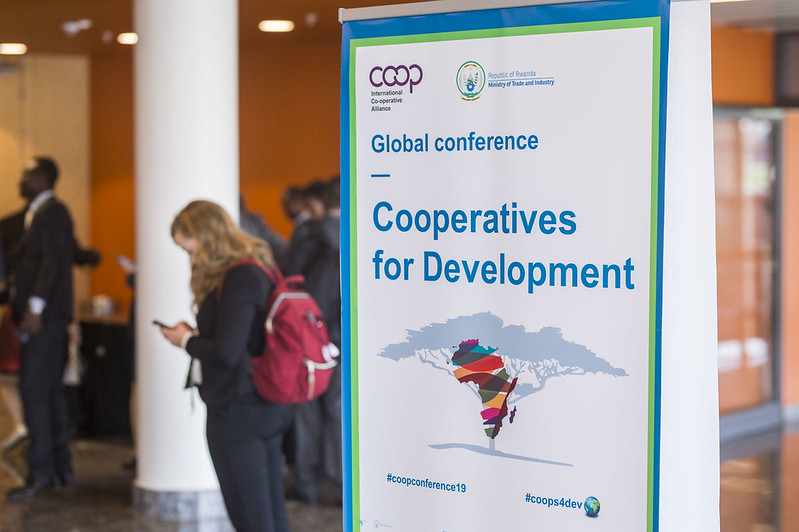
Promotional standee at the ICA conference in Kigali. Image credit: ICA
On October 15, during the ICA International conference in Kigali, Rwanda, four parallel sessions looked at how cooperatives can be key actors of collective action to achieve the UN’s Agenda 2030 and the Sustainable Development Goals (SDGs). Each session addressed a different goal, within the context of the significance of multi-stakeholder partnerships.
Parallel session 1: Tackling inequalities through the cooperative movement (SDG 10)
The session bought a rich dialogue among ICA member organisations, cooperative representative organisations and external experts (local authorities, global institutions, private sector) on tackling inequalities and the issue of impact measurement. Case studies showcased experiences and tools used by cooperatives in tackling inequalities, whilst external experts gave feedback, advice and a general overview of experiences working in partnership with the cooperative movement.
Parallel session 2: Women’s empowerment at the forefront of sustainable development (SDG 5)
This session approached gender equality with emphasis on how policy agendas and the cooperative model can support processes encouraging self-empowerment for all and particularly for women. The session also illustrated the importance of building new partnerships between the cooperative movement and actors sharing the same values and principles of putting people before profit. A high level panel, four cases and a joint discussion brought about many learnings and insights, of which, the importance of approaching gender equality as a priority for both women and men (1), women`s access to education (2), women`s leadership (3) and gender mainstreaming of activities, projects and programs (4) were highlighted as key strategies of achieving gender equality within- and via the cooperative movement – and are thus guiding the recommendations.
Parallel session 3: Innovation in entrepreneurship through the cooperative model (SDG 9)
With the objective of understanding how the cooperative business model has fostered innovative entrepreneurship and functions as a catalyst of inclusive and sustainable development, during the first part of the session, cooperative entrepreneurs from diverse backgrounds and business fields shared with the audience their experiences including both successes and failures acquired when starting their respective cooperative. The four showcased field cases were coming from the 4 regions of ICA (Africa, Europe, America and Asia Pacific) and they represented different vulnerable groups such as youth, refugees, women and on people with disabilities. Regardless of their political, social, cultural and economic situation, all of them presented very similar challenges faced in their daily life: lack of opportunity, exclusion, minimum financial aid and no low representation on the drafting of social policy. At the same time, for all of them the cooperative model was one of the best options in order to start their entrepreneurship project due to its principles of cooperation, collaboration and sharing.
For the second part of the session, political representatives from CSOs, social networks and the government of Rwanda were invited to take the floor in order to address the challenges already put on the table by the field cases. During this part, the importance of partnership between cooperatives and other actors was mentioned as one of the most important points when talking about entrepreneurship and underrepresented groups. The cooperative movement was strongly encouraged to collaborate more with social networks and to avoid working in insolation. At the same time, there was also acknowledgement of the need to make more efforts and provide economic support in making sure that no one is left behind. The session finished with all the panelists pledging to work on their fields in order to enable a better environment for cooperative entrepreneurship both at a local and international level.
Parallel session 4: Globalization of inclusive ethical value chains
This session aimed at elaborating on the significance of multi-stakeholder partnerships and the role that the cooperative movement can play in moving the globalization of value chains in a fair, ethical and inclusive direction. Representatives of the European Union, civil society, multi-actor networks and the Cooperative movement highlighted that cooperatives facilitate individual producers’ collective voice and negotiation power with key players across the supply chain for fairer returns to their members and communities; cooperatives at both ends of the supply chain have been joining forces to shorten value chains, improve product traceability and adopt environmentally friendly practices; human due diligence is key to fair and ethical value chains; financial support and investment into programming for the implementation Agenda 2030 needs to be dedicated to multi-stakeholder partnership initiatives –SDG Fund; partnerships with like-minded organisations like Fairtrade movement and other multi-stakeholder networks for South-South /Global-South Cooperation need to fostered by political and financial frameworks that allow for this, boosting their capacity to reach the poorest of the poor and address local needs that are linked to global challenges.
The discussion was further enriched by case studies from 3 geographical areas showcasing examples of the impact of cooperatives at local communities embedded in value chains (south-south, global –south cooperation). Youth, women and informal workers have been in the spotlight while exchanging on inclusive value chains and it was repeatedly mentioned that cooperatives are agents of change, they can boost livelihood opportunities, shape leaders that put people and their prosperity before profit, they are key actors for inclusive growth towards just economies and societies for all.


