
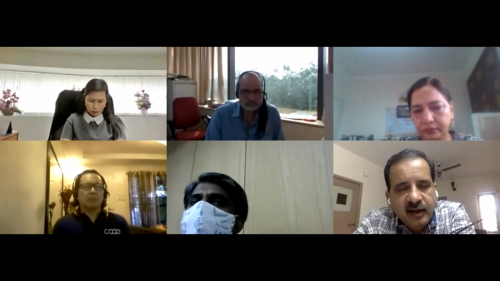
ICA-AP organized a follow-up webinar on 29th October 2020 for its Regional Capacity Building Programme on SDG-13: Climate Action. Participants from Asian Confederation of Credit Unions (ACCU), Thailand; NATCCO Network, Philippines; Indian Farmers Fertiliser Cooperatives (IFFCO) and Krishak Bharati Cooperatives (KRIBHCO), India, presented reports on the actions taken by them post the training.
The capacity building programme was held from 19 to 21 November 2019 at the CLT Training Center, Bangkok, Thailand on the theme: “Save the Environment to Sustain Future Generations.” The program was co-organised by ICA members - Cooperative League of Thailand (CLT) and All China Federation of Supply and Marketing Cooperatives (ACFSMC) and the ICA-EU Partnership Project. The training curriculum was designed by experts from the Training Centre at GIZ, Thailand in consultation with ICA-AP.
The training was in line with ICA’s commitment to strengthen the capacity of members in responding to Climate Change and aimed at senior executives and leaders of cooperatives. It focused on understanding the urgency of climate action, spread awareness, and take steps to address the effects.
The two-day training was attended by 24 participants from eight countries including China, India, Philippines, Maldives, Thailand, Vietnam, Botswana, and Nigeria. The training concluded with action points to be implemented by participants using the skills and learnings from the training.
Due to the COVID-19 induced travel restrictions, the follow-up for Climate Action training was done via webinar. Mr. Balu Iyer, Regional Director, ICA-AP, delivered the opening address and Mrs. Savitri Singh, Program Director, facilitated the discussions. The reports from the participants were encouraging and some of them had established skill development programmes to train and multiply trainers to spread awareness and impart necessary skills to the coop members. For example, ACCU and NATTCO jointly organized a training programme for staff from 13 cooperatives in the Philippines. The task of the graduating trainers or ‘Climate Warriors’ is to train cooperatives, spread awareness about best practices, and multiply the number of trainers across all their cooperatives.
Ms. Elenita V. San Roque, CEO of ACCU said that they have taken a lead and introduced Climate Action mechanism in their credit union (CU) network. The CU Business Solution 26: Guide to Climate Action RECOGNIZES the impact of climate change to humanity; the URGENT need to integrate climate action in the daily lives of members and CU operations; leverage the SIGNIFICANT FORCE of CU network (36 million strong in Asia (members) and 34,000 institutions); develop an EVOLVING MENU of climate action programs which sends out the message that even the smallest contributions can counter a global climate challenge. It’s the little things that matter most.
ACCU has created information and awareness posters for members. Among their climate action initiatives are:
- Adding the 6th C of Credit – Climate Compliance in Loan Assessment
- Do-it-yourself Energy/Climate Audit
- Credit Union Self-Assessment Waste Audit and Management
- Waste Audit for Business
- Climate Finance 6. Integrating Climate Actions in ACCU Business Solutions wherever applicable
Mr. Leonardo S. Banga from NATCCO-Micoop Group of Philippines reported that micro action completed within four months of the training including meeting with stakeholders at the primary level to discuss the urgency of the climate issue; pushing for the inclusion of SDG-13 as one of the strategic objectives in the annual plan and target of primary coops; promoting the practice of reduce, reuse and recycle; and reviewing credit /loan products attune to climate protection.
Mr. Sudhir Kumar Sharma, Manager from IFFCO reported that social responsibility and social accountability are key to the growth and development of the coop members. Coops should take effective measure to promote sustainable production and delivery to the farmers and rural communities. He listed the key initiatives by IFFCO for climate action such as nano fertilisers to ensure sustainable use of Agri inputs, bio-fertilisers, Save the Soil Campaign, sustainable agroforestry, neem plantation for a clean environment, etc.
Mr. L.P. Goodwin, Chief Manager from KRIBHCO, in his report, presented action taken in the form of awareness campaign; education on soil health, proper use of fertilizer and other farm inputs; and planting of trees.
A few participants from ICA Africa region could not present their reports but they participated in the discussion through the chatbox.
In his concluding remarks, Mr. Balu Iyer expressed happiness on the actions taken by the participants and said that ICA will continue to engage with members on SDG-13 and organize capacity building programmes in the future.


