
COVID-19 has majorly disrupted educational services around the world. For over eight months, teaching has shifted online; schools and universities in most countries continue to put in-person education in abeyance until it is safe to collectivise on campuses for classes, networking, and extra-curricular activities. With the third wave of COVID-19 erupting in some parts of the world, uncertainty looms large over every sphere of life. Education remains one of the seriously affected sectors among many, especially with limited access to digital resources for students and teachers from the marginalised backgrounds to continue ‘education-as-usual’.
Cooperatives in educational institutions, like other economic enterprises, are also facing the brunt of the ongoing pandemic with the inability to operate and serve its members physically on campuses. The disruption of normal educational activities has affected businesses and jobs for the students, the teachers, and the staff involved in campus cooperatives as members or part-time employees; along with posing other challenges, such as lack of in-person networking, isolation, insecurity about self, career, and future.
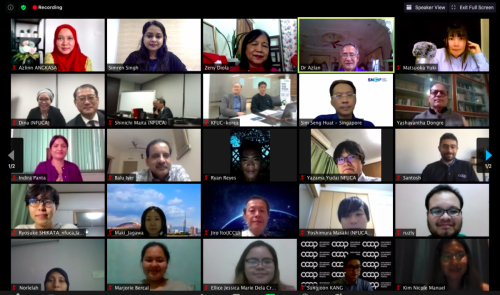
The ICA Asia and Pacific Committee on Cooperatives in Educational Institutions (ICEI) organised a webinar on 5th November 2020 to discuss the impact of COVID-19 on education and cooperatives in educational institutions (campus cooperatives) in Japan, Malaysia, Singapore, and South Korea. The webinar was attended by 50 participants representing ICA members, ICA staff, students, and educators in Asia and the Pacific.
Mr. Balu Iyer, Regional Director of ICA-AP inaugurated the webinar. In his address, he remarked that the pandemic has exposed many inadequacies and inequities in the education systems around the world. Moving further, as public funds will be increasingly directed towards health and social welfare, there is a risk of curtailed public spending on education in the long term. Therefore, in the given scenario, it becomes critical to assess the impact of disrupted on-campus education during the pandemic on campus cooperatives and ascertain what can be done to mitigate the long-term impact on members. He also underlined the need for increased digitalisation in campus cooperatives and implementation of Cooperative Principle 6 (Cooperation among Cooperatives) at the domestic and the international level to support campus cooperative businesses and members’ wellbeing.
Dr. Mohd. Azlan Yahya, Chairperson of ICEI and Vice-President of ANGKASA, shared the ongoing challenges of schools and school cooperative businesses in Malaysia. Over 800 children in primary schools and 1,300 children in secondary schools have been infected since the first wave of Coronavirus in Malaysia. Schools have been mostly closed until now and those which are gradually trying to reopen are facing an altogether new challenge. Parents and children are developing ‘school phobia’ due to the rising number of cases. As a result, a sharp decline in school attendance has been reported. On the other hand, campus cooperatives in schools are suffering due to reduced sales and revenue.
Mr. Shinichi Maita, Vice-Chairperson of ICEI; Managing Director and CEO of National Federation of University Co-operative Associations (NFUCA), discussed the impact of the pandemic on higher education and university cooperatives. In Japan, admissions and graduation ceremonies in March-April were halted. Classes were postponed and university campuses were closed during the national emergency which lasted for seven weeks between April and May. Since May, however, universities have adopted a hybrid model of teaching with most of the classes being held online. It was noted that NFUCA surveyed with about 35,000 undergraduate and graduate students to understand the impact of the pandemic on university cooperatives and support required by students. The findings of the survey indicated a decrease in household income for those who were part-time workers in university cooperatives; reduced opportunities for networking and socialising for new students as they did not get an opportunity to meet and interact with one another personally; scepticism about timely completion of studies and securing jobs after graduation; and dissatisfaction with a virtual learning environment as opposed to the physical learning environment. Further, it was reported that estimated operational turnover for university cooperatives has gone down compared to the last year. However, no capital shortage was reported in the Financial Year 2020.
Similar insights on the status of education and university cooperatives were shared by Mr. Kim Jong-weon, member of ICEI and President of Korea Federation of University Co-operatives (KFUC), South Korea. Classes in schools and universities are being conducted in a hybrid manner. Courses that require practical and laboratory application and with less than twenty enrolled students are being conducted offline, while rest are held remotely using online platforms. It was reported that even though access to online education is not a major challenge, quality of classes/lectures cannot be fully ensured using online platforms. Teachers also are finding it increasingly difficult to record lectures on their own. Further, there are more than 200 universities in South Korea and only 35 of them have campus cooperatives (stores, cafes, etc.). Due to the ongoing pandemic, only 40% of them are currently operational and their sales have sharply reduced (by 47%) compared to 2019, even though social-distancing and health protocols are being followed.
To address some of these challenges, several measures are being adopted by the cooperatives to support and engage with students. Mr. Sim Seng Huat, member of ICEI and Senior Manager (campus and youth) at Singapore National Co-operative Federation (SNCF), shared that cooperative clubs in Singapore are engaging with school and university students through online workshops on cooperatives, awareness sessions, and training sessions on entrepreneurship. Similarly, measures like online orientation meetings with new students in Japan, partial operation of cooperative stores and cafes in Japan and South Korea and outlook to devise new business models for school cooperatives in Malaysia are being undertaken.
The webinar ended with a positive note that despite the operational challenges faced by campus cooperatives, there has been no complete shutdown of businesses and employee layoffs. In his closing remarks, Dr. Azlan thanked the participants and ICEI members for sharing useful insights from their countries. The webinar was moderated by Prof. Zeniada Diola (Co-Secretary), Dr. Yashwanth Dongre (Co-Secretary) and Ms. Simren Singh (Secretary) from ICEI.


