
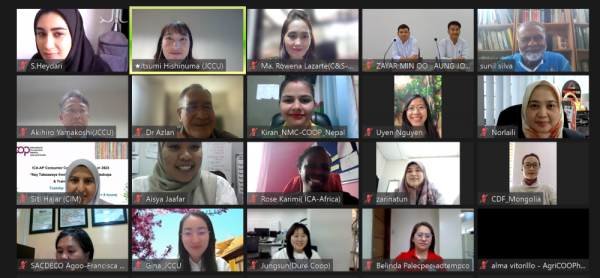
ICA-AP Committee on Consumer Cooperation organized its first webinar in 2023 on March 14 to discuss the “Key Takeaways from the Committee Workshops & Training Programs.” It was attended by 41 participants from 20 countries in Asia and Africa.
The webinar aimed to look at the past training programs and workshops which the Committee co-hosted with its member organizations before the pandemic. By reviewing and finding what the participants learned there and how they applied the learnings to their businesses and activities in their co-ops, the committee tried to understand how to strengthen the cooperative movements in the Asia-Pacific region and organise effective workshops and training programs in the next few years.
Mr. Akihiro Yamakoshi, Committee Chair and Manager of the International Relations Department of the Japanese Consumers’ Co-operative Union, JCCU opened the webinar. He noted that the ICA-AP Consumer Committee's activities have been affected by the pandemic which forced them to suspend the on-site trainings and workshops for 3 years. Since the world is starting to return to a pre-pandemic lifestyle, the committee is planning to resume its training programs and workshops this year. He hoped that the webinar will help in understanding the training needs of the members.
Ms. Itsumi Hishinuma, the Committee Secretary provided an overview of the committee and its training programs and workshops. She said that the Consumer Committee was established in 1977 with the aim to help promote consumer coop activities in the Asia-Pacific region. Currently, the committee consists of 17 organizations from 12 countries. On-site training programs in Japan have been conducted every year since 1991 where about 5 trainees were invited to a two-week program. Its aim is to make participants learn and expose them to the management systems and practices of Japanese consumer cooperatives and adapt the experiences and skills gained to their own cooperatives. Regional workshops have been also organized in several countries in the region since 2000 for the participants to visit consumer coops of other countries and learn from good examples and practices of consumer coops.
Five guest speakers made a presentation on their learnings from the training programmes, how they applied learnings to their own coops and their expectations from future programs and workshops.
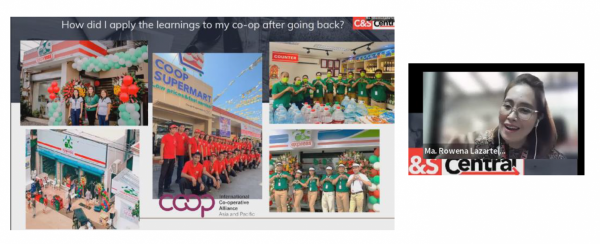
Ms. Ma. Rowena Lazarte, Brand Manager of C&S Central, Philippines was the trainee in the “Training Programs for Managers of Consumer Co-ops in Miyagi prefecture in Japan in 2019.” She mentioned learning a lot about the retail industry such as consumer behaviour, emerging technology, customer service (how to deal with complaints and meet customer expectations), and team management (collaborative team effort and feedback system between management, employees and customers). She noted that she was inspired during the workshop and was motivated to increase the number of C&S stores in the Philippines. As a result, despite the pandemic and with limited resources, the number of modern generation stores of C&S increased from 1 to 5 and another one would also open at the end of March 2023. Relationship between coop members and coop staff was also learnt in Japan and she upgraded the C&S service to be more member oriented. Her expectations of JCCU and ICA-AP are to open an investment/ partnership with them, to be supportive, to provide education about new generation stores and to increase the opportunities of exchanging coop products among coops in other countries.
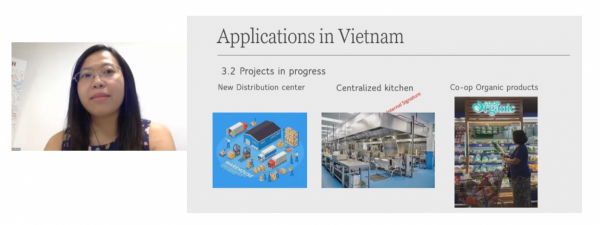
Ms. NGUYỄN ĐẮC ANH UYÊN from Saigon Coop, Vietnam interviewed the trainees from Saigon and reported on their behalf. Many of the trainees were impressed with the mindset of responsibilities and inner discipline of Japanese consumer coops, the mail ordering business (home delivery service), the automatic warehouse of Coop Kobe and recycling factories. The participants felt the most important thing for the cooperative is caring about members as well as staff. Thus, they started to organize activities for members and staff such as giving gifts on their birthdays, financially supporting staff in difficulties, and providing special prices for members. They also have plans to establish a new distribution centre to improve the logistic system which serves the network of over 800 stores of Saigon Coop. The centralized kitchen or food factory has been planned to be established with the aim to reduce the difference in the quality of cooked products depending on staff and each store. They have also tried to develop organic food products. She requested that the training programs and workshops in the future should focus on specific topics and not the operation in general so that participants can learn from the experience and knowledge of the organizers more productively.
Dr. Norlaili Mohamed Yatin from ANGKASA, Malaysia participated in the ICA-AP Regional Workshop for Managers on “Management of Consumer Co-ops” in Singapore in 2016, co-hosted by NTUC FairPrice. She was pleased to see the whole process of the supply chain of NTUC FairPrice and to get the opportunity to pick products from its distribution centre. She said NTUC’s motto is “Service from the heart” and with this, staff can happily serve their customers and bring more profit. They also learned the importance of trainings for operation teams to enhance effectiveness in retail operations as well as a marketing plan to provide special prices on public holidays such as Mother’s Day. She transferred her knowledge and information gained during the workshop to her staff in her department. She expects future workshops to be strategically planned to learn the management and operation of logistic systems. In addition, she would like to have an event which gives opportunities for coops in the Asia Pacific region to market their coop products to each other.
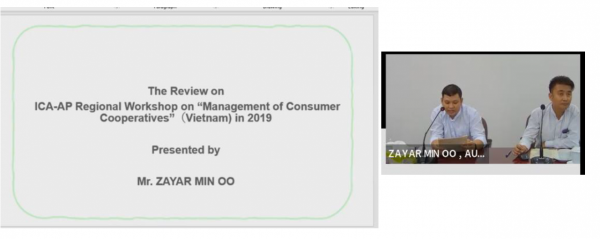
Mr. Zay Yar Min Oo, Board of Directors of Hlaing Thar Yar Township Cooperative Federation, Myanmar was a participant in the Regional Workshop for Managers on “Management of Consumer Co-ops” in Vietnam in 2019. After his brief explanation about the workshop in Vietnam, he mentioned that Saigon Coop is a representative retail of multipurpose cooperatives and is leading in modern retail technologies and has many store formats to attract customers in Vietnam. In Myanmar, consumer coops are not very active and some have very traditional retail stores without modern technology. Therefore, he planned to introduce technologies such as computer software for display, tried to provide one-stop services to meet customer needs and has planned to launch new coop stores in collaboration with other township cooperatives in the Yangon region. He expects future workshops to provide learnings of merchandising (effective display and selling), market analysis and supply chain.
Ms. Siti Hajar Saaey from the Cooperative Institute of Malaysia, (CIM) was a participant in Regional Workshop in Korea, in 2019. She said she was impressed with the contribution of iCOOP to the community, its communication with members, organizations, and farmers; and to provide consumers with reliable and eco-friendly agricultural products. iCOOP also puts ethical consumption into practice by establishing National Dream Park and integrating its supply chain management. Since she works in an institution that provides training and cooperative knowledge, she shared her knowledge and learnings with people in her class and her workshop session. There, she emphasized that members of iCOOP not only put in money but also enrol in each activity and meet the needs of members through their services and products. In future events, she would like to learn about cooperative sustainability, especially after the pandemic era, how staff can gain knowledge on entrepreneurship and management, how to get support from existing members, and how to increase their new members.
All the speakers said that they had valuable experiences in the training programs and workshops. Ms. Itsumi thanked all speakers and participants for attending the meeting and said that the Committee will reflect on what was learned from the presentations to prepare for future events in working together with committee members.


