
Women in the informal economy have borne a disproportionate brunt of the COVID-19 pandemic due to the triple crisis of health, livelihood and additional care. The impact on them, socially, economically and politically, have reversed the positive effects of work over the past half-century in one fell swoop. While the world, by and large, is resuming with the increasing availability of vaccines, women workers are still struggling with the increased burdens of care work, economic uncertainty, and a shrinking and consolidating labour markets.
SEWA Cooperative Federation, WIEGO and International Cooperative Alliance – Asia and Pacific (ICA-AP), as part of the week-long celebrations on National Cooperative week in India organized a webinar, Rebuilding an Inclusive World in the Wake of the Pandemic: Women Cooperatives Lead the Way.’ The webinar was an opportunity for practitioners and thought-leaders from the social and solidarity economy (SSE) to come together, understand the data and brainstorm solutions to the challenges faced by women in the informal economy during and in the aftermath of the COVID-19 pandemic (and associated lockdowns) across the world.
Conducted over two hours on 19 November, the webinar had around 120 registrations from 28 countries and was translated into as many as 8 languages to allow for greater engagement from grassroots actors. The webinar was split into three back-to-back panels of researchers, practitioners and subject area experts.
The first panel featuring Homenet South Asia, SEWA Cooperative Federation, and ICA-AP, presented the results of research studies into the impact of COVID-19 on informal women workers and their enterprises (both micro-enterprise and collective ones), focusing on contexts in India, South Asia and Asia. The second panel covered a more global experience with presentations by grassroots leaders from Nigeria, Nepal, the Dominican Republic, and India sharing their experiences of countering the socio-economic and health impact of the pandemic and steps that could be taken to hasten women’s recovery.
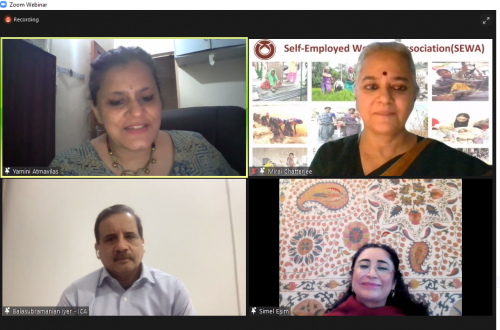
The third and final panel was an opportunity for leaders to consolidate the learnings of the previous two panels into a more tangible roadmap for policy advocacy efforts in the coming year. The panel included Simel Esim from the ILO, Balasubramanian Iyer from ICA-AP and Mirai Chatterjee from SEWA Cooperative Federation. One of the key takeaways from this panel was the need to set an agenda for upcoming national and international conferences, including the ICA’s 33rd World Cooperative Congress (WCC), the ILO’s 2022 International Labour Conference (ILC), where SSE has been specially included as a discussion item to help better respond to COVID-19, and several others at the local and regional level. In preparation for these conferences, there is a need to synthesise the existing research work of various organisations where many similarities exist. Joint publications are one way to take this forward. Leading up to the ILC, this could take the form of a joint position paper expressing shared views around the SSE.
SSE enterprises and cooperatives have an incredible ability to innovate due to their value-based approach and centrality of principles in their work. To improve their resilience, such enterprises need to connect across sectors to strengthen each other and local supply chains. Cooperative alliances can assist with this and also have immense potential to advocate for better social protection, more capacity-building and targeted policy action, factors especially relevant to women workers in the informal sector. As they are capable of pivoting to meet basic needs inclusively, women’s cooperatives should play a greater role in disaster response. However, given the lack of a supportive ecosystem, they account for barely 3% of cooperatives in India (reflecting trends across the world) and require investments to sustain themselves and grow. This is especially relevant in the face of increasing digitisation and a rapidly changing policy landscape, which requires a significant investment through incubation funds, working capital support and tax holidays among others.
SEWA Cooperative Federation has published a report titled ‘Building Resilience & Strengthening our Solidarity: A Study of Women's Collective Enterprises during COVID-19’ which studies the impact of the second COVID wave on 15 collective social enterprises, owned by informal women workers. This builds on their earlier study into the impact of the first wave of the pandemic and associated lockdowns on women workers in the informal sector (November 2020).


